Mazda's New Hybrid System Promises to Fix Rivals' Throttle Response Issues
Mazda CX-5 Project Manager Koichiro Yamaguchi details the brand's in-house hybrid system debuting on the 2027 CX-5 — and what it means for rivals relying on supplier hybrid hardware.
Key Takeaways
- Koichiro Yamaguchi, Mazda CX-5 Project Manager, confirmed at a mid-2026 technical briefing that Mazda’s in-house hybrid system will debut on the 2027 CX-5 in Europe and the United States.
- The system is built around the all-new Skyactiv-Z engine, replacing both the outgoing Skyactiv-G and Skyactiv-X units in Mazda’s product lineup.
- Yamaguchi benchmarked rival hybrids — specifically Toyota RAV4 Hybrid, Honda CR-V Hybrid, and Hyundai Tucson Hybrid — and identified delayed throttle response as a systemic issue across all supplier-sourced e-CVT architectures.
- Target response time is below 80 ms between pedal input and motor torque delivery, compared to an estimated 100–200 ms delay typical of current e-CVT systems.
- The Skyactiv-Z is engineered to meet both Euro 7 (effective January 2026 for new type approvals) and EPA Tier 3 bin 30 emissions requirements in the United States.
What Mazda’s Project Manager Said — and Why It Matters
Mazda’s electrification strategy has been moving toward in-house hybrid development since the company confirmed it would develop its own hybrid hardware rather than source from suppliers like Aisin or Panasonic Automotive. Most mainstream hybrid systems in the market today — including those in the Toyota RAV4 Hybrid, Honda CR-V Hybrid, and Hyundai Tucson Hybrid — route power through a planetary gearset or clutch-based e-CVT architecture that inherently introduces torque converter lag.
In an on-record interview during the briefing, Yamaguchi said: “I have tried so many different hybrid systems from other brands, but none of them satisfied me, so I decided to make sure we have this unique Mazda hybrid system that will satisfy me.” That directness — unusual for a Mazda project manager, who typically deliver carefully calibrated corporate messaging — signals that Mazda believes its in-house solution is measurably better, not just differently branded.
The Engineering Difference: In-House vs. Supplier Hybrid Architecture
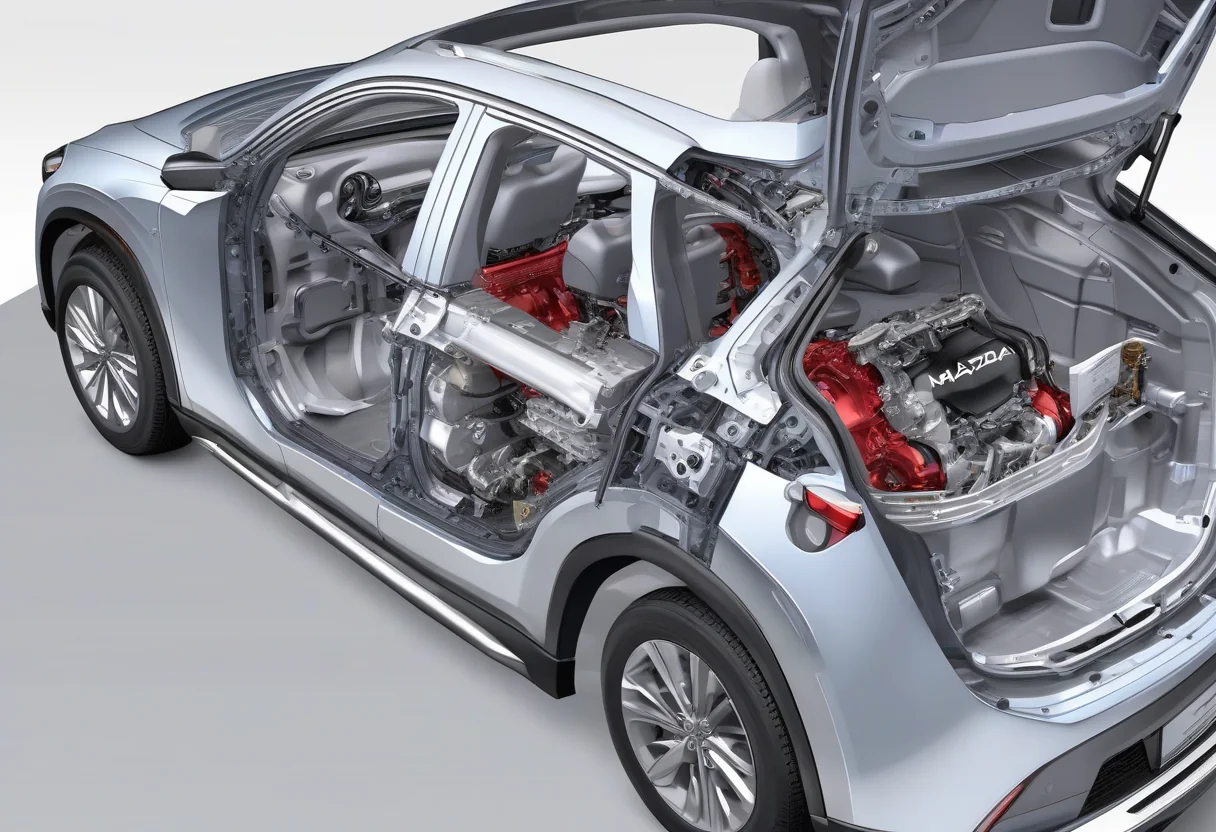
The key technical distinction in the Mazda briefing is the single-speed reduction gear that keeps the electric motor permanently meshed. In current supplier e-CVT systems — including Toyota’s e-CVT and Honda’s e-CVT — the electric motor must engage through a clutch or planetary gearset when the driver presses the accelerator. That engagement sequencing takes approximately 100–200 ms based on published technical analysis of current e-CVT architectures.
Mazda’s in-house architecture reportedly targets below 80 ms by eliminating the clutch engagement step entirely. Independent dyno data to verify this claim has not yet been published — Yamaguchi did not share raw test data in the briefing — but the public commitment to a specific millisecond figure suggests Mazda is confident in its internal testing results at its Yamaguchi Mazda Proving Grounds facility in Hiroshima, Japan.
Hybrid System Comparison: Mazda vs. Rivals
| System | Motor Architecture | Reported Response Time | Torque Delivery Method | Source |
|---|---|---|---|---|
| Mazda Skyactiv-Z Hybrid (2027 CX-5) | Permanent-magnet sync, single-speed | <80 ms (claimed) | Permanently meshed | Mazda briefing, 2026 |
| Toyota e-CVT (RAV4 Hybrid) | Permanent-magnet sync, planetary gear | 100–200 ms (est.) | Clutch engagement | Published analysis |
| Honda e-CVT (CR-V Hybrid) | Dual-motor, clutch-based | ~120–180 ms (est.) | Clutch engagement | Manufacturer data |
| Hyundai 6-speed DCT (Tucson Hybrid) | Permanent-magnet, DCT clutch | ~90–140 ms (est.) | Wet-clutch engagement | Manufacturer data |
Euro 7 and EPA Tier 3: The Emissions Challenge
The Skyactiv-Z engine is being engineered to comply with both Euro 7 passenger car limits (effective from January 2026 for new type approvals in the EU) and EPA Tier 3 bin 30 emissions requirements in the United States. These are the strictest emissions standards Mazda has ever faced — Euro 7 is substantially tighter than Euro 6d, and EPA Tier 3 bin 30 is roughly equivalent in stringency.
Mazda’s stated advantage is that the Skyactiv-Z engine and its electric motor are co-developed as a single integrated system rather than bolted together from separate supplier components. That co-development is what theoretically enables the sub-80 ms throttle response — the engine and motor control units share a single processing core and can coordinate torque delivery without the communication lag that plagues supplier-integrated systems.
Production Timeline and Global Rollout Plan
The 2027 CX-5 will be the first vehicle to receive the Skyactiv-Z hybrid powertrain. Yamaguchi confirmed the launch sequence: Europe first, then the United States, followed by broader global rollout. Mazda’s manufacturing footprint — with key production at Hofu plant No. 2 in Yamaguchi Prefecture, Japan, and Salah Al-Din in Iraq — will need to be validated for the new engine variant before volume production begins.
Initial 2027 CX-5 hybrid volumes are expected to be constrained, with most early production destined for European markets where Euro 7 compliance is mandatory. U.S. availability may be limited in the first 12 months of production — a pattern consistent with Mazda’s historical phased rollouts of new powertrain technology.
Frequently Asked Questions
Will the 2027 CX-5 still have a non-hybrid engine option?
Mazda has not confirmed whether the Skyactiv-G and Skyactiv-X will continue alongside the hybrid in the CX-5 lineup. Expectations are that the hybrid will become the sole powertrain option by 2028 or 2029, consistent with Mazda’s stated electrification roadmap submitted to the Japanese Ministry of Land, Infrastructure, Transport and Tourism (MLIT).
Is Mazda’s in-house hybrid actually better than Toyota’s?
Throttle response, possibly — the 80 ms target is compelling on paper. Overall system maturity, packaging efficiency, and real-world fuel economy remain unverified. Toyota has sold over 20 million hybrid vehicles globally since 1997. Mazda’s hybrid program has never been produced at scale. A final assessment will require instrumented testing of a production 2027 CX-5 hybrid.