Louis Vuitton and Singer Create Two Bespoke Porsche 911s with Exquisite Attention to Detail
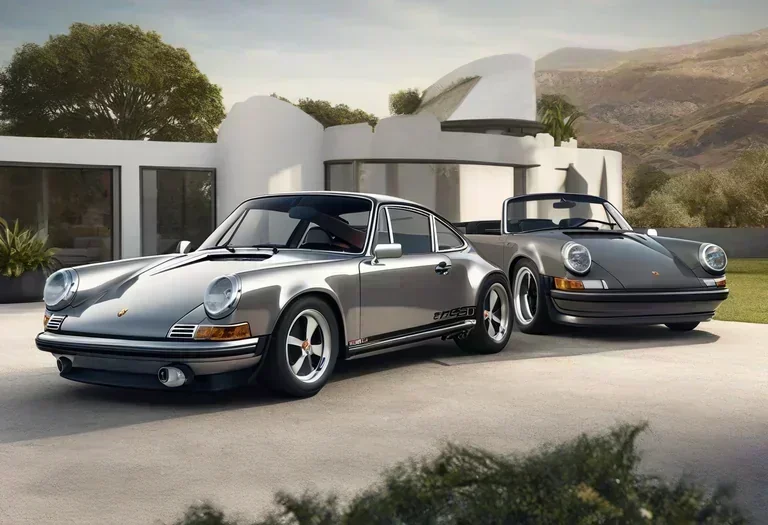
Louis Vuitton and Singer have unveiled two bespoke Porsche 911s with manual gearboxes, custom interiors, a Tambour-inspired clock and unique luggage.
Key Takeaways
- Louis Vuitton and Singer Vehicle Design have created two bespoke Porsche 911 reimaginations based on the 964 platform.
- The collaboration produced a saffron-and-cobalt-blue Singer Classic coupe and a limestone-and-gold Classic Turbo Cabriolet.
- Both cars use carbon-fiber bodywork, rear-wheel drive and six-speed manual transmissions.
- The Classic uses a naturally aspirated 4.0-liter air-cooled flat-six, while the Turbo Cabriolet gets a 3.8-liter twin-turbo flat-six with air-to-water intercooling.
- A removable Louis Vuitton dashboard clock inspired by the Tambour watch became the starting point for the wider collaboration.
- Both cars feature extensive Louis Vuitton design details, bespoke luggage and matching accessories.
- Louis Vuitton and Singer have not disclosed prices for the two cars.
Why Did Louis Vuitton and Singer Build These Porsche 911s?
Louis Vuitton and Singer Vehicle Design have joined forces to create two highly bespoke Porsche 911 reimaginations, bringing together the French luxury house’s expertise in leather, luggage and watchmaking with Singer’s approach to restoring and reengineering classic Porsche 911s.
The collaboration began with a relatively simple request: Singer wanted Louis Vuitton to help create a special dashboard clock. What started as an instrumentation project eventually expanded into a much more comprehensive design partnership covering the cars’ interiors, accessories and other details.
The two finished cars were unveiled during Monterey Car Week in August 2026. Rather than simply applying Louis Vuitton branding to existing Singer builds, the project incorporates design techniques and materials associated with the fashion house throughout both cars.
What Are the Two Louis Vuitton Singer Porsches?
The first car is the Singer Classic, a 964-based coupe finished in saffron and cobalt blue. It combines a carbon-fiber body with a naturally aspirated 4.0-liter air-cooled flat-six engine, a six-speed manual transmission and rear-wheel drive.
The second is the Singer Classic Turbo Cabriolet, a convertible with a lighter Calcaire Lutétien-inspired exterior and gold detailing. It uses a 3.8-liter twin-turbocharged flat-six, air-to-water intercooling, a six-speed manual transmission and rear-wheel drive.
Both cars retain the fundamental character of the classic 911 while incorporating modern engineering and extensive bespoke craftsmanship.
What Makes the Singer Classic Special?
The Singer Classic is finished in a combination of saffron and cobalt blue, with design elements that reference both Louis Vuitton’s visual heritage and Singer’s history of creating colorful Porsche commissions.
Its carbon-fiber body is paired with a naturally aspirated 4.0-liter air-cooled flat-six producing a reported 420 horsepower. Power is sent through a six-speed manual transmission to the rear wheels.
The car also features carbon-ceramic brakes, titanium exhaust components and a speed-activated rear spoiler. A roof rack adds a particularly unusual touch, with enough space for a Louis Vuitton trunk, surfboard or skis.
Inside, the cabin combines naturally colored leather with yellow stitching and hand-finished metal controls. Louis Vuitton’s design language appears through details including its Monogram Flower motif, quilted Malletage-inspired patterns and techniques normally associated with the construction of the company’s luggage.
What Makes the Classic Turbo Cabriolet Different?
The Classic Turbo Cabriolet takes a more nautical approach to its design. Its Calcaire Lutétien-inspired white exterior is paired with gold details and a large whale-tail rear spoiler.
Underneath the carbon-fiber bodywork is a 964-based chassis with a 3.8-liter twin-turbocharged flat-six. The engine uses air-to-water intercooling and is paired with a six-speed manual gearbox.
The Cabriolet also features selectable driving modes, allowing the driver to alter the character of the car rather than relying solely on the traditional mechanical configuration.
One of its most distinctive features is the extensive use of wood. The rear luggage deck, bumpers and interior trim draw inspiration from classic Italian runabout boats, giving the convertible a very different character from the sportier coupe.
What Is Special About the Louis Vuitton Dashboard Clock?
The dashboard clock is arguably the most direct connection between the cars and Louis Vuitton’s watchmaking division.
The clock was inspired by the Louis Vuitton Tambour, a watch first introduced in 2002 that became one of the brand’s signature timepieces. Louis Vuitton’s current Tambour collection continues to emphasize the model’s distinctive case design and handcrafted watchmaking.
For the Singer collaboration, the dashboard clock was designed as a removable unit. When taken out of the car, it can be used as a desk clock.
The surrounding instruments were also designed to complement the clock, creating a cohesive dashboard rather than simply installing a conventional automotive timepiece.
Louis Vuitton’s official Tambour history provides more background on the watch that inspired the dashboard design: Louis Vuitton Tambour.
How Much Louis Vuitton Design Is Inside?
The collaboration goes considerably further than the dashboard clock.
The cars use techniques associated with Louis Vuitton’s leather goods, including quilting, edge-dying and distinctive pattern work. The coupe incorporates the Monogram Flower motif and Malletage-inspired quilting in several areas of the cabin and luggage compartments.
Even relatively small components received attention. Door handles, controls, vents, switches and other metal elements were hand-finished rather than left as conventional mass-produced pieces.
The Cabriolet takes a more understated approach, with nautical-inspired materials and wood trim. Its gearshift surround reportedly draws inspiration from the construction and drawstring details of Louis Vuitton’s Noé bag.
Do the Cars Come With Louis Vuitton Luggage?
Yes. The collaboration extends beyond the vehicles themselves with bespoke Louis Vuitton luggage and accessories designed to complement each car.
The package includes custom travel pieces and driving-related equipment matched to the materials and color schemes of the individual cars. Depending on the car, the accessories include items such as driving gloves, footwear, clothing, sunglasses and a helmet.
This makes the project closer to a complete lifestyle commission than a conventional automotive collaboration.
How Much Does Each Car Cost?
Louis Vuitton and Singer have not announced pricing for either vehicle.
That is not particularly surprising given the level of customization involved. Singer’s commissions are individually specified and can command prices well into the millions depending on the donor car, engineering specification and level of bespoke work.
Because these two vehicles were created as highly individualized collaboration pieces, their final values cannot be reliably estimated from the price of a standard Singer commission.
Are the Louis Vuitton Singer Porsches Available to Buy?
There is no announced public ordering program or conventional production run for the two collaboration cars.
They were presented as bespoke vehicles created through the partnership, and neither company has announced a retail allocation, production schedule or customer pricing.
That means prospective buyers should not treat the cars like a new Porsche model that can simply be ordered through a dealership.
How Much Work Goes Into a Singer Porsche?
Singer’s approach involves far more than restoring an old Porsche. The company takes classic 911s and reimagines them with modern engineering, extensive bodywork and individually specified interiors.
For the Louis Vuitton project, that philosophy was combined with a second layer of craftsmanship. The cars were designed to incorporate processes normally associated with high-end fashion, luggage and watchmaking.
The result is an unusual intersection of automotive restoration, motorsport engineering, luxury goods and haute horlogerie.
Why Is the Collaboration Significant?
The partnership is notable because the two companies operate in very different industries but share an emphasis on small-scale craftsmanship and customization.
Singer has built its reputation around reimagining air-cooled Porsche 911s, while Louis Vuitton has spent more than a century developing luxury travel goods and has expanded into watches and other forms of design.
The collaboration shows how those disciplines can overlap. The cars use automotive engineering as their foundation, while the interiors and accessories apply techniques more commonly associated with luxury luggage and watchmaking.
Is This Louis Vuitton’s First Automotive Collaboration?
The modern Singer project represents a particularly significant automotive design effort for Louis Vuitton, but the company’s connection with cars goes back much further.
Louis Vuitton’s heritage includes an early automotive project from 1909, when Pierre and Jean Vuitton, grandsons of the company’s founder, designed a sports car to help showcase the house’s products.
More than a century later, the Singer collaboration brings the brand back into automotive design through two highly customized Porsche 911s.
Frequently Asked Questions
What are the Louis Vuitton Singer Porsche 911s?
They are two bespoke Porsche 911 reimaginations created by Singer Vehicle Design in collaboration with Louis Vuitton. One is a Classic coupe and the other is a Classic Turbo Cabriolet.
What engine does the Singer Classic use?
The Singer Classic uses a naturally aspirated 4.0-liter air-cooled flat-six engine producing a reported 420 horsepower and paired with a six-speed manual transmission.
What engine does the Classic Turbo Cabriolet use?
The Classic Turbo Cabriolet uses a 3.8-liter twin-turbocharged flat-six with air-to-water intercooling and a six-speed manual transmission.
Do both Louis Vuitton Singer Porsches have manual transmissions?
Yes. Both the Classic coupe and Classic Turbo Cabriolet use six-speed manual transmissions.
What is the Louis Vuitton dashboard clock?
It is a removable dashboard clock developed as part of the collaboration and inspired by Louis Vuitton’s Tambour watch. The clock can also be used as a desk clock when removed from the vehicle.
Do the cars come with Louis Vuitton luggage?
Yes. Both vehicles are accompanied by bespoke Louis Vuitton luggage and accessories designed to complement their individual colors and materials.
How much do the Louis Vuitton Singer Porsches cost?
No pricing has been announced for either car. The vehicles were created as bespoke commissions rather than conventional mass-production models.
Can you buy one of the Louis Vuitton Singer Porsches?
No public production or ordering program has been announced for the two collaboration vehicles. They were presented as bespoke creations.
Pros and Cons
Pros
- Exceptional bespoke craftsmanship
- Two unique Porsche 911 designs
- Six-speed manual transmissions
- 4.0-liter naturally aspirated flat-six in the Classic
- 3.8-liter twin-turbo flat-six in the Cabriolet
- Distinctive Louis Vuitton-inspired interiors
- Removable Tambour-inspired dashboard clock
- Matching bespoke luggage and accessories
Cons
- No announced pricing
- No public availability information
- Extremely limited bespoke nature
- Likely to be inaccessible to most buyers
- Extensive customization makes direct comparison with standard 911 models difficult
Specifications
| Specification | Singer Classic | Classic Turbo Cabriolet |
|---|---|---|
| Base platform | Porsche 911 Type 964 | Porsche 911 Type 964 |
| Body style | Coupe | Cabriolet |
| Bodywork | Carbon fiber | Carbon fiber |
| Engine | 4.0-liter naturally aspirated air-cooled flat-six | 3.8-liter twin-turbocharged flat-six |
| Power | 420 hp | Approximately 510 hp |
| Transmission | 6-speed manual | 6-speed manual |
| Drivetrain | Rear-wheel drive | Rear-wheel drive |
| Intercooling | Not applicable | Air-to-water |
| Brakes | Carbon-ceramic | Carbon-ceramic |
| Exterior theme | Saffron and cobalt blue | Calcaire Lutétien white and gold |
| Distinctive feature | Roof rack and removable Tambour-inspired clock | Wood luggage deck and nautical-inspired trim |
| Pricing | Not announced | Not announced |
Official sources: Louis Vuitton Tambour | Singer Vehicle Design