Hyundai's Georgia Plant Could Become America's Largest Car Factory
Hyundai is considering expanding its Georgia plant to produce 800,000 vehicles annually by 2028, making it the largest car factory in the US.
Key Takeaways
- Hyundai is considering expanding its Georgia Metaplant to produce 700,000 to 800,000 vehicles annually by 2028.
- If the 800,000-unit target is reached, Hyundai Motor Group Metaplant America (HMGMA) could become the largest single-site finished-vehicle production facility in the United States.
- Hyundai wants more than 80% of the vehicles it sells in the U.S. to be built domestically by 2030, up from about 40% in 2024.
- The company is also evaluating additional U.S. investment for body-on-frame trucks and SUVs, potentially expanding Hyundai’s presence in the pickup and off-road segments.
- Hyundai’s U.S. market share increased from 8.4% in 2020 to 11.2% in 2025, highlighting the importance of local production to its growth strategy.
- The proposed expansion is part of Hyundai Motor Group’s broader $26 billion U.S. investment plan through 2028.
Why Is Hyundai Expanding Its Georgia Plant?
Hyundai is considering a major expansion of Hyundai Motor Group Metaplant America (HMGMA) in Georgia, potentially increasing annual production capacity from the current 500,000-vehicle target to between 700,000 and 800,000 vehicles by 2028.
Hyundai CEO José Muñoz disclosed the potential increase in a CNBC interview on August 20, 2026. The proposal is part of the automaker’s broader strategy to increase U.S. manufacturing, shorten supply chains, and reduce its dependence on imported vehicles.
The move also comes as Hyundai accelerates its localization strategy in response to changing U.S. trade conditions. Muñoz said the company’s existing localization efforts were already underway before the latest tariff changes and that the policy environment has encouraged Hyundai to move faster.
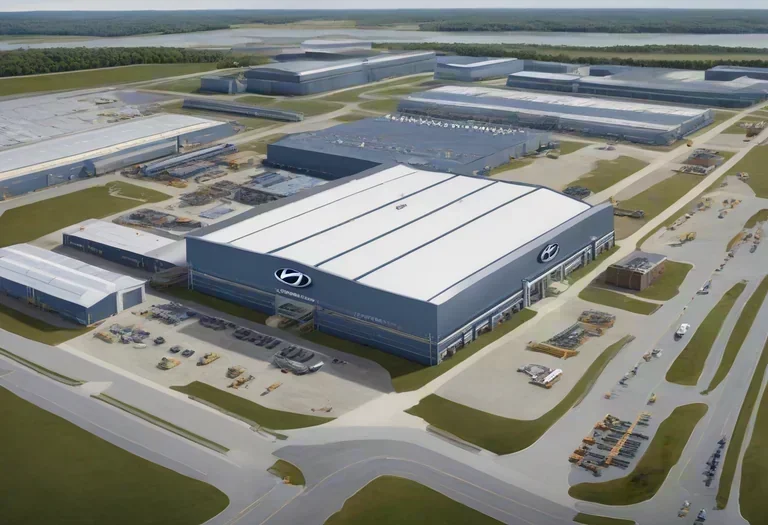
The Hyundai Motor Group Metaplant America is located near Savannah, Georgia, and is designed as a flexible manufacturing facility capable of producing multiple models and powertrain types. The plant currently builds the Hyundai Ioniq 5, Hyundai Ioniq 9, and Kia Sportage Hybrid.
Could the Georgia Metaplant Become America’s Largest Auto Factory?
Potentially. If Hyundai expands HMGMA to 800,000 vehicles per year, the Georgia facility would be capable of producing more finished vehicles at a single site than the largest competing U.S. vehicle assembly operations.
| HMGMA Production Plan | Annual Capacity | Status |
|---|---|---|
| Current planned capacity | 500,000 vehicles | Established expansion target |
| Potential near-term capacity | 700,000 vehicles | Under consideration |
| Potential maximum capacity | 800,000 vehicles | Under consideration for 2028 |
It is important to distinguish between planned capacity and actual production. Hyundai is considering the expansion; the company has not yet confirmed that the Georgia facility will definitely produce 800,000 vehicles annually.
The existing plant was officially opened in 2025 and was initially expanded to support up to 500,000 electric and hybrid vehicles annually across Hyundai, Kia, and Genesis products. HMGMA’s flexible manufacturing system can build different models and propulsion systems on the same production infrastructure.
Hyundai’s 80% U.S. Production Target
The proposed Georgia expansion is closely tied to Hyundai’s goal of building more of the vehicles it sells in America inside the United States.
Hyundai currently estimates that about 40% of its U.S. sales were produced domestically in 2024. The company wants to increase that figure to more than 80% by 2030.
| Metric | Current / Previous | Hyundai Target |
|---|---|---|
| U.S. vehicles produced domestically | About 40% in 2024 | More than 80% by 2030 |
| HMGMA annual capacity | 500,000 vehicles | 700,000-800,000 by 2028 under consideration |
| U.S. market share | 8.4% in 2020 | 11.2% in 2025 |
Hyundai’s localization strategy extends beyond vehicle assembly. The company has also announced plans involving U.S. parts and logistics operations and a new Hyundai Steel facility in Louisiana. Hyundai Motor Group’s broader U.S. investment program is intended to increase manufacturing capacity and strengthen the domestic supply chain.
What Vehicles Does Hyundai Build in Georgia?
HMGMA has quickly expanded its vehicle lineup. The plant began production of the Hyundai Ioniq 5 in 2024, followed by the Ioniq 9 in 2025. In 2026, production expanded again with the addition of the Kia Sportage Hybrid.
| Vehicle | Brand | Powertrain | Georgia Production |
|---|---|---|---|
| Ioniq 5 | Hyundai | Electric | Yes |
| Ioniq 9 | Hyundai | Electric | Yes |
| Sportage Hybrid | Kia | Hybrid | Yes |
The plant is designed to be considerably more flexible than a traditional single-model assembly operation. According to HMGMA, its manufacturing system can accommodate up to 10 different vehicles, giving Hyundai Motor Group room to add additional models as U.S. demand and production requirements change.
Could Hyundai Build a New U.S. Pickup Truck?
Hyundai is also evaluating additional U.S. investment for body-on-frame trucks and SUVs. The company has not confirmed a specific production model or plant for these vehicles, so reports of a future midsize pickup should be treated as a possibility rather than a confirmed product announcement.
A body-on-frame truck would give Hyundai an opportunity to compete more directly in one of the most important segments of the U.S. market. The company currently sells the unibody Santa Cruz pickup, but a larger body-on-frame model could target customers looking for greater towing, payload, and off-road capability.
The potential investment would also complement Hyundai’s growing SUV lineup and provide additional locally built products to support its goal of having more than 80% of U.S. sales produced domestically by 2030.
How Fast Is Hyundai Growing in the U.S.?
Hyundai’s expansion comes after several years of increasing U.S. market share. According to data cited in reporting on the company’s latest plans, Hyundai’s U.S. market share increased from 8.4% in 2020 to 11.2% in 2025.
Hyundai Motor North America also reported that Hyundai and Genesis dealerships sold more than 1.19 million vehicles in 2025, an 8% increase from 2024. The company’s expanding U.S. product portfolio has included electric vehicles, hybrids, SUVs, and performance models, increasing the need for additional production capacity.
Local manufacturing could help Hyundai respond more quickly to U.S. demand while reducing exposure to import costs and supply-chain disruptions. It also gives the company greater flexibility to adjust production between models as consumer preferences change.
What Does the Expansion Mean for the U.S. Auto Industry?
If Hyundai proceeds with the proposed expansion, the impact would extend beyond the company itself. A Georgia facility capable of producing up to 800,000 vehicles annually would require a substantial supporting network of suppliers, logistics companies, and other manufacturing businesses.
Hyundai Motor Group has already described its U.S. manufacturing strategy as a major source of employment and economic activity. The group says its existing U.S. operations have supported hundreds of thousands of direct and indirect jobs, while the Metaplant and related investments are expected to create additional employment.
The expansion could also intensify competition in several key segments. More U.S.-built Hyundai, Kia, and Genesis vehicles would give the group additional capacity to compete against established American, Japanese, and European automakers, particularly as demand for hybrids, EVs, SUVs, and trucks continues to shape the U.S. market.
What Happens Next?
For now, the 800,000-vehicle target is a proposal under consideration, not a finalized production commitment. Hyundai’s current HMGMA plan calls for 500,000 vehicles of annual capacity, while CEO José Muñoz has said the company is evaluating an increase to 700,000-800,000 units by 2028.
The final scale of the expansion will determine how quickly Hyundai can move toward its goal of producing more than 80% of its U.S.-sold vehicles domestically. The company is also expected to continue evaluating additional U.S. manufacturing opportunities for trucks, SUVs, hybrids, and electric vehicles.
Frequently Asked Questions
How many vehicles could Hyundai’s Georgia plant produce?
Hyundai is considering increasing the annual capacity of Hyundai Motor Group Metaplant America in Georgia from 500,000 vehicles to between 700,000 and 800,000 vehicles by 2028. The 800,000-unit figure is a potential target, not yet a confirmed production level.
Will Hyundai’s Georgia plant become the largest auto factory in the U.S.?
If HMGMA reaches 800,000 vehicles of annual capacity, it could become the largest single-site finished-vehicle production facility in the United States. The distinction refers to production capacity at one site, rather than Hyundai Motor Group’s total U.S. production.
What is Hyundai’s U.S. manufacturing goal?
Hyundai aims to have more than 80% of the vehicles it sells in the United States built domestically by 2030. The company estimates that roughly 40% of its U.S. sales were locally produced in 2024.
What vehicles are currently built at Hyundai’s Georgia Metaplant?
HMGMA currently produces the Hyundai Ioniq 5, Hyundai Ioniq 9, and Kia Sportage Hybrid. The facility is designed to accommodate additional models and different powertrain types.
Is Hyundai building a new U.S. pickup truck?
Hyundai is evaluating additional U.S. investment for body-on-frame trucks and SUVs, but the company has not confirmed a specific new pickup model or production location. A future midsize truck is therefore not yet a confirmed production vehicle.
How much is Hyundai investing in the United States?
Hyundai Motor Group has announced a broader $26 billion U.S. investment commitment through 2028. The program covers vehicle manufacturing as well as steel, parts, logistics, technology, and other U.S. operations.