Infiniti's Concept Car That Never Made It to Production Featured a 1.2L Engine and 402 HP
Infiniti's Emerg-e concept car was unveiled in 2012 with a 1.2L engine and 402 HP, but never made it to production.
Key Takeaways
- The Infiniti Emerg-E was unveiled at the 2012 Geneva Motor Show as a mid-engine electric sports car concept built around a range-extender powertrain.
- It used two electric motors producing a combined 402 HP, with each motor rated at 201 HP and driving the rear wheels.
- A 1.2-liter three-cylinder Lotus engine served as a range extender, generating electricity rather than mechanically driving the wheels.
- The Emerg-E used a roughly 15 kWh lithium-ion phosphate battery and could travel more than 30 miles on electric power before the range extender was needed.
- Infiniti claimed a 0-60 mph time of 4.0 seconds and a top speed of 130 mph, making the concept both an efficiency showcase and a serious performance car.
- The exterior was designed by California-based Infiniti designer Randy Rodriguez, with design development carried out by Nissan Design Europe.
- The concept was closely related technically to the Lotus Evora 414E Hybrid and used an aluminum chassis architecture derived from the Lotus Evora.
- The Emerg-E was never developed into a production Infiniti, although Infiniti ultimately continued exploring electrification, range-extender technology, and new design directions through later concepts.
What Made the Emerg-E So Special?
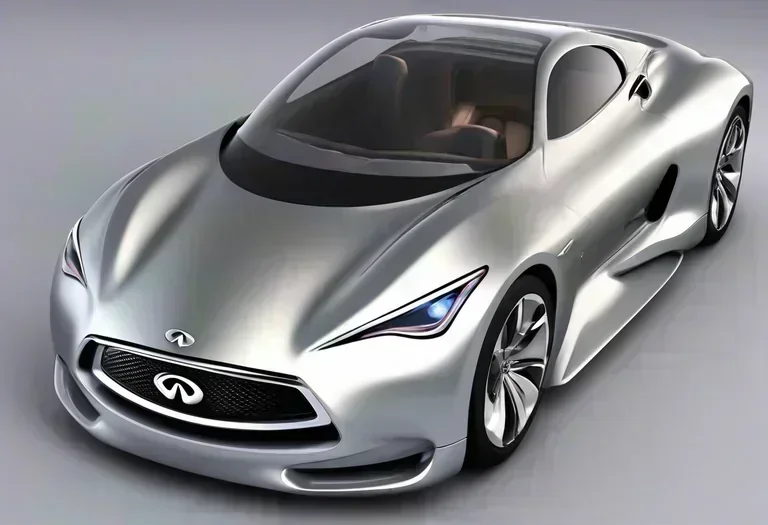
The Infiniti Emerg-E was one of the most ambitious concept cars unveiled by Infiniti during the early 2010s. Revealed at the 2012 Geneva Motor Show, the two-seat sports car combined dramatic mid-engine proportions with an unusual electrified powertrain that placed electric motors at the center of the driving experience.
At first glance, the Emerg-E looked like a conventional high-performance mid-engine sports car. Its low body, wide stance, large rear haunches, and sculpted sides suggested that a large gasoline engine was hiding behind the cabin. Instead, the car was propelled by two electric motors, one driving each rear wheel.
Each motor was rated at 201 horsepower, giving the Emerg-E a combined peak output of 402 horsepower. The electric motors produced their power through a single-speed transmission, allowing the concept to deliver immediate acceleration without the conventional multi-speed gearbox associated with a gasoline-powered sports car.
The gasoline engine was much smaller than the car’s performance figures might suggest. The Emerg-E used a 1.2-liter three-cylinder engine developed with Lotus specifically for range-extending duties. It did not directly drive the wheels. Instead, the engine operated as a generator, producing electricity to support the battery and electric drivetrain once the available battery charge was depleted.
That made the Emerg-E a range-extended electric vehicle rather than a conventional hybrid in which an internal-combustion engine and electric motor both mechanically contribute to propulsion. The concept could therefore operate as an electric sports car for its initial driving range while retaining a gasoline-powered generator for longer journeys.
Infiniti claimed the Emerg-E could travel more than 30 miles using electric power alone. Once the battery reached a low state of charge, the 1.2-liter range extender could generate additional electricity, giving the concept a claimed combined range of approximately 300 miles.
The performance figures were equally striking for 2012. Infiniti quoted a 0-60 mph acceleration time of 4.0 seconds and a top speed of 130 mph. Those numbers demonstrated that Infiniti was not treating electrification solely as an efficiency exercise. The Emerg-E was intended to show that electric propulsion could deliver both low-emissions driving and serious sports-car performance.
The concept also represented an important collaboration between Infiniti, Nissan’s European engineering operations, Lotus, and several British technology companies. Its development was supported through the United Kingdom’s Technology Strategy Board program, which helped bring together companies working on electric motors, batteries, power electronics, lightweight structures, and other technologies.
The official Infiniti news archive describes the Emerg-E’s design development and the work of California-based designer Randy Rodriguez: Infiniti Emerg-E.
The Design of the Emerg-E
The Infiniti Emerg-E’s design remains one of the strongest reasons the concept continues to attract attention more than a decade after its debut. Unlike many futuristic concept cars that can quickly look dated, the Emerg-E used proportions and surfacing that still look remarkably close to what a modern electric sports car could be.
The exterior design originated with Randy Rodriguez at Infiniti’s California design studio. His proposal was selected from competing designs created by Infiniti’s design centers in California, Japan, and Europe. The winning theme was then developed further through Nissan Design Europe in London.
Infiniti wanted the Emerg-E to demonstrate that a mid-engine sports car did not have to adopt the extremely aggressive wedge-shaped appearance associated with many exotic cars. Instead, the designers emphasized flowing surfaces and a long, low profile intended to communicate what Infiniti called graceful power.
The car’s proportions were also unusual for Infiniti at the time. The mid-engine configuration allowed the designers to create a compact cabin positioned between prominent front and rear sections. Large rear air intakes helped manage cooling requirements while becoming one of the car’s most recognizable visual features.
The front end incorporated Infiniti’s signature design language, while the rear section became substantially more muscular. The roofline flowed into the rear bodywork, creating a smooth transition between the passenger compartment and the powertrain area.
Another distinctive element was the crescent-shaped cutout around the rear pillar. Infiniti considered this an emerging design signature, and the Emerg-E demonstrated how the feature could be incorporated into a dramatic sports-car body.
The body itself used lightweight carbon-fiber panels over an aluminum chassis. The concept measured approximately 175.7 inches long, 76.9 inches wide, and 48 inches high, giving it the low-slung proportions expected of a serious sports car.
Inside, Infiniti continued the futuristic theme without turning the cabin into a purely decorative concept-car exercise. The two-seat cockpit was designed around the driver, with flowing surfaces, advanced digital displays, and a distinctive central structure separating the occupants.
The interior used a combination of premium materials and technology to reinforce the concept’s position between a luxury grand tourer and a performance car. The result was an interior that felt connected to Infiniti’s luxury identity while demonstrating how digital interfaces could change the traditional sports-car cockpit.
The Emerg-E’s design is particularly interesting in hindsight because Infiniti continued developing an electrified design language through later concepts. The brand’s subsequent electric and electrified concepts continued exploring low-slung proportions, flowing surfaces, and the freedom that alternative powertrains provide to designers.
The Technology Behind the Emerg-E
The Emerg-E’s powertrain was arguably more important than its exterior design. At a time when most performance hybrids still relied on a conventional engine as the primary source of propulsion, Infiniti developed the concept around electric motors that were responsible for driving the car.
The two electric motors were mounted to drive the rear wheels and produced 201 horsepower each. Together, they delivered 402 horsepower, while the electric drivetrain also provided approximately 738 lb-ft of combined torque according to period specifications.
The motors were connected through a single-speed Xtrac transmission. Because electric motors can deliver strong torque across a broad operating range, the system did not require the multi-speed transmission typically used with an internal-combustion sports car.
Power came from a lithium-ion battery positioned behind the seats. Contemporary specifications commonly list the battery at approximately 14.8 kWh, generally rounded to 15 kWh. The battery used lithium-ion phosphate chemistry, a choice associated with durability and thermal stability.
The battery could be charged from an external electrical supply. Infiniti claimed that the concept could travel approximately 30 miles under electric power before the range-extender system became necessary.
Once the battery needed additional energy, the 1.2-liter three-cylinder Lotus-developed engine started operating as a generator. The engine produced approximately 35 kW, or about 47 horsepower, but its job was not to provide direct mechanical propulsion. Its purpose was to generate electricity for the vehicle’s electric drivetrain.
This distinction is central to understanding the Emerg-E. The small gasoline engine was not intended to make the sports car fast. The electric motors were responsible for performance, while the gasoline engine served as an energy source that allowed the vehicle to continue operating after the initial electric range had been used.
The concept also incorporated regenerative braking. During deceleration, the electric motors could recover some kinetic energy and send it back into the battery. That helped improve overall efficiency while providing another way for the electric system to manage energy.
The Emerg-E’s engineering extended beyond its powertrain. The car used a bonded and extruded aluminum chassis with carbon-fiber body panels, helping keep weight under 1,600 kilograms. Aerodynamic development and cooling were also important because the electric motors, battery, and power electronics all generated heat that had to be controlled.
The project brought together technology from several British engineering organizations. Lotus contributed the range-extender engine technology, while EVO Electric supplied the electric motors and Xtrac developed the single-speed transmission. Nissan’s European Technical Centre coordinated much of the engineering work.
The result was a concept that demonstrated an approach to electrified performance that has become increasingly familiar in the years since. The Emerg-E separated propulsion from energy generation: electric motors provided the driving force while a smaller combustion engine could generate electricity when additional range was needed.
Why the Emerg-E Never Made It to Production
The Infiniti Emerg-E was designed as a technology demonstrator and concept rather than a straightforward preview of a production model. Although Infiniti executives discussed the possibility of producing the car or using its technology in future vehicles, the Emerg-E ultimately never entered series production.
That outcome was not unusual for a concept as ambitious as the Emerg-E. The car combined expensive technologies, a low-volume sports-car body, carbon-fiber construction, a sophisticated electric drivetrain, and a specialized range-extender system. Turning that combination into a commercially viable production vehicle would have required substantial investment.
The market also presented challenges. In 2012, battery-electric technology was still developing rapidly, charging infrastructure was far less widespread than it is today, and premium electric performance cars were a relatively small market. A high-performance range-extender sports car would have been expensive to engineer and manufacture while serving a very limited customer base.
There was also a question about where the Emerg-E fit within Infiniti’s product strategy. Infiniti was primarily focused on luxury sedans, coupes, and crossovers, while the Emerg-E represented a dramatic departure into exotic mid-engine sports-car territory.
The concept did, however, achieve its purpose as a technology and design statement. It demonstrated that Infiniti could combine electrification with performance and showed how a different powertrain could create new opportunities for vehicle design.
The Emerg-E also should not be viewed as an isolated experiment. It shared technology with the Lotus Evora 414E Hybrid concept, which had already demonstrated a similar range-extender approach. The Emerg-E represented Infiniti’s interpretation of that architecture and adapted it to the brand’s own design language and performance goals.
Although the Emerg-E itself never reached production, Infiniti continued exploring electrified vehicles through subsequent concept cars. The company later introduced concepts such as the QX Inspiration, Qs Inspiration, Prototype 9, and Prototype 10 as part of its continuing exploration of electrification and future design.
Infiniti’s current concept portfolio continues to emphasize electrified propulsion and design experimentation. The brand’s official future-concept vehicle lineup shows how electrification became an increasingly central part of Infiniti’s design strategy after the Emerg-E era.
Specifications
| Specification | Value |
|---|---|
| Vehicle Type | Two-seat mid-engine range-extended electric sports car concept |
| Debut | 2012 Geneva Motor Show |
| Gasoline Engine | 1.2-liter three-cylinder Lotus-developed range extender |
| Engine Output | Approximately 35 kW (47 HP) |
| Electric Motors | 2 x 201 HP |
| Combined Electric Output | 402 HP / 300 kW |
| Drive Layout | Rear-wheel drive |
| Transmission | Single-speed Xtrac transmission |
| Battery | Approximately 14.8 kWh lithium-ion phosphate |
| Electric Range | Approximately 30 miles |
| Combined Range | Approximately 300 miles |
| 0-60 mph | 4.0 seconds |
| Top Speed | 130 mph |
| Chassis | Bonded and extruded aluminum |
| Bodywork | Carbon fiber |
| Designer | Randy Rodriguez |
| Production Status | Concept only; never entered production |
Frequently Asked Questions
Q: What was the Infiniti Emerg-E?
The Infiniti Emerg-E was a two-seat sports-car concept unveiled at the 2012 Geneva Motor Show. It used a range-extended electric powertrain, with two electric motors driving the rear wheels and a 1.2-liter three-cylinder gasoline engine serving as a generator.
Q: How much horsepower did the Infiniti Emerg-E have?
The Emerg-E had a combined electric output of 402 horsepower. It used two 201-horsepower electric motors, with one motor driving each rear wheel.
Q: What engine did the Infiniti Emerg-E use?
The concept used a 1.2-liter three-cylinder engine developed with Lotus for range-extender duty. The engine produced approximately 35 kW, or about 47 horsepower, and was used to generate electricity rather than directly drive the wheels.
Q: Was the Infiniti Emerg-E a hybrid?
The Emerg-E used a range-extended electric vehicle configuration. It was different from a conventional parallel hybrid because the gasoline engine was not mechanically connected to the wheels. The electric motors provided propulsion, while the gasoline engine generated electricity when additional energy was required.
Q: How far could the Infiniti Emerg-E travel on electric power?
Infiniti claimed an electric-only driving range of approximately 30 miles. Once the battery’s available charge was depleted, the gasoline range extender could generate electricity to support continued driving.
Q: What was the Infiniti Emerg-E’s total driving range?
Infiniti claimed a combined range of approximately 300 miles when the electric battery and gasoline-powered range extender were used together.
Q: How fast was the Infiniti Emerg-E?
The Emerg-E had a claimed 0-60 mph time of 4.0 seconds and a top speed of 130 mph. Its 402-horsepower electric drivetrain gave the concept performance comparable to serious sports cars of its era.
Q: Who designed the Infiniti Emerg-E?
The exterior design was created by Randy Rodriguez at Infiniti’s California design studio. His proposal won an internal design competition involving Infiniti studios in California, Japan, and Europe, after which the design was further developed through Nissan Design Europe.
Q: Was the Infiniti Emerg-E based on a Lotus?
Yes. The Emerg-E was closely related to Lotus technology. Its aluminum chassis architecture was derived from the Lotus Evora, while the range-extender powertrain was related to technology used in the Lotus Evora 414E Hybrid concept.
Q: What type of battery did the Emerg-E use?
The Emerg-E used a lithium-ion battery with phosphate chemistry and an energy capacity of approximately 14.8 kWh, commonly rounded to 15 kWh. The battery was mounted behind the seats.
Q: Why did the Infiniti Emerg-E never go into production?
The Emerg-E remained a concept because its advanced technology, lightweight construction, specialized powertrain, and low-volume sports-car configuration would have made it expensive and difficult to commercialize. Infiniti ultimately did not turn the concept into a production model.
Q: Is the Infiniti Emerg-E still relevant today?
Yes. The Emerg-E is notable because several ideas it explored have become more common in modern electrified vehicles. Its combination of electric propulsion, a range-extender generator, regenerative braking, lightweight construction, and software-managed energy use anticipated technologies that have continued to develop across the automotive industry.
Q: Did Infiniti continue developing electrified concepts after the Emerg-E?
Yes. Infiniti subsequently introduced several electrified and electric concept vehicles, including the QX Inspiration, Qs Inspiration, Prototype 9, and Prototype 10. These concepts continued the brand’s exploration of electric propulsion and how electrification could influence vehicle design.