The Rise of Mundane Classics: Why Everyday Cars Are Becoming Collectibles
Classic car ownership is shifting towards more common, affordable vehicles from the 90s and 2000s, driven by nostalgia and a desire for fun, drivable cars.
Key Takeaways
- Gen-Z classic car policies grew 48 percent year over year at Hagerty, the fastest-growing segment in the hobby.
- Hagerty has more than doubled the number of 2000s Honda Civics and Toyota Corollas it insures in just three years.
- The most-quoted car among Gen-Z enthusiasts is the 1990-1998 Mazda Miata, while Millennials favor GMT400 trucks.
- Nostalgia, affordability and social media are driving demand for ordinary 90s and 00s cars.
- The 2026 Festival of the Unexceptional sold out with 4,500 visitors and 2,500 cars; the winner was a 176,000-mile 2001 Volkswagen Polo E.
What Is Driving the Mundane Classic Boom?
Classic car ownership is no longer the exclusive domain of six-figure exotics and trailer-queen restorations. A quiet shift is underway in which thoroughly ordinary cars from the 1990s and 2000s are being insured, collected and celebrated as the classics of tomorrow. The data behind the trend is unusually clear.
Hagerty’s 2024 “Future of Driving” survey, conducted by OnePoll among more than 2,000 Americans, found that 60 percent of Gen-Z respondents expressed an interest in owning a classic car someday, against just 31 percent of Baby Boomers. The same survey reported that 32 percent of Gen-Z and 30 percent of Millennials said they had already owned or currently own a classic or enthusiast vehicle.
The insurance books tell the same story from the other side. According to Hagerty figures reported in 2026, the company’s average customer was 53 years old, but Gen-Z policies grew 48 percent year over year — the fastest-growing cohort in the book. Hagerty has also more than doubled the count of 2000s Honda Civics and Toyota Corollas it insures in three years. The boring cars of the recent past are quietly becoming the collector cars of the present.
Which Everyday Cars Are Becoming Collectible?
The surge is not limited to one model or one generation. Hagerty’s own quote data shows the 1990-1998 Mazda Miata is the most common car Gen-Z enthusiasts ask to insure, a roadster that sold more than 1.1 million units across its history and now reads as the affordable sports car of their childhood. Millennials, slightly older, gravitate toward GMT400 trucks from 1988 to 2000.
Other once-ubiquitous nameplates are climbing the same curve. Hagerty reports that policies on the 1984-1988 Toyota Pickup 4x4 have quadrupled since 2017, with owners under 40 more than doubling their share of the model from 7 percent in 2019 to 16 percent. These are not rare homologation specials. They are the trucks, hatchbacks and sedans that filled commuter lots and high-school parking lots a generation ago.
The pattern is consistent: the cars people remember from their formative years are the ones they want to own now. That emotional pull is precisely what turns a mass-produced economy car into a future classic, regardless of how unremarkable it seemed when new.
Why Are Ordinary Cars Gaining Value?
Three forces overlap to explain the move. The first is nostalgia. A 2001 Volkswagen Polo or a 1990s Corolla is not valuable because of its engineering; it is valuable because it represents a specific moment in the owner’s life. Hagerty’s survey found that 40 percent of younger enthusiasts said their first exposure to classic and enthusiast cars came from attending car shows, while YouTube and Instagram ranked among the top ways Gen-Z interacts with the hobby.
The second is affordability and access. Unlike a Ferrari or a Porsche 911, a tired economy car from the 1990s is reachable on a modest budget, which lowers the barrier to entry for a generation that often faces higher living costs than its predecessors. A first classic that costs less than a used smartphone removes the intimidation factor that surrounds traditional collector cars.
The third is the disappearance of the simple car. Modern vehicles are software-defined, screen-heavy and difficult for owners to service. The analog switchgear, manual transmissions and mechanical feedback of a 90s hatchback feel increasingly special precisely because they have vanished from new cars. What was once merely basic now reads as character.
What Does the Festival of the Unexceptional Tell Us?
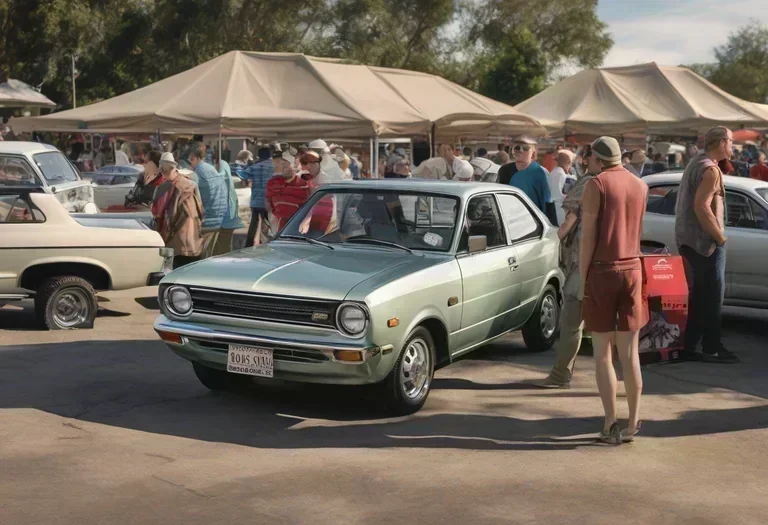
No event captures the mood better than the Hagerty Festival of the Unexceptional (FOTU), a celebration of the dull and the daily that has grown from a small gathering into one of Britain’s most distinctive car events. The 2026 edition, the 12th running, took place at Grimsthorpe Castle in Lincolnshire and sold out, drawing 4,500 visitors and a field of 2,500 cars ranging from Ladas and Yugos to a Fiat Strada convertible and a Toyota Corona Mark II pick-up.
The headline trophy, the Concours de l’Ordinaire, went to Gordon McNeill and his battle-scarred 2001 Volkswagen Polo E — a base-spec car with 176,000 miles and worn paint that beat far more pristine entries precisely because it embodied the spirit of the event. A decade earlier the 2014 debut drew a handful of cars; by 2024 the show fielded around 2,000 cars and 4,000 visitors, with a 1982 Toyota Hilux taking top honors. The trajectory is the clearest possible signal that the mundane classic has gone mainstream.
Is a Mundane Classic a Good Investment?
The enthusiasm is real, but the investment case deserves caution. Classic car values are not guaranteed to rise, and the mundane segment is especially uneven. Price depends on originality, condition, documentation, mileage, rarity and broader economic conditions, and a forgotten Corolla is not automatically a appreciating asset just because it is old.
The smarter framing is to buy the car you actually want to drive and maintain, not the one you hope will appreciate. An enjoyable vehicle with strong parts availability and a supportive owner community — the Miata is the textbook example — is a better first purchase than a rare project requiring fabrication and specialist knowledge. Treat any future value as a pleasant bonus rather than the reason for the purchase.
For new collectors, the practical steps are straightforward: set a realistic total budget that includes insurance, storage and repairs; compare agreed-value policies rather than standard auto cover; find a mechanic familiar with the model; and always commission a pre-purchase inspection. The goal is to join the hobby with eyes open, not to chase a speculative return on a car that was never meant to be precious.
Frequently Asked Questions
Q: Why are younger buyers interested in classic cars?
A: Hagerty’s 2024 survey found 60 percent of Gen-Z respondents were interested in owning a classic car, driven by nostalgia for the cars of their childhood, social media exposure, and the affordability of ordinary 90s and 00s models compared with traditional exotics.
Q: Which mundane cars are becoming collectibles?
A: The 1990-1998 Mazda Miata is the most-quoted car among Gen-Z enthusiasts, while Honda Civics, Toyota Corollas and Toyota Pickup 4x4s have seen sharp rises in insurance policies. Millennials show the strongest interest in 1988-2000 GMT400 trucks.
Q: What is the Festival of the Unexceptional?
A: It is a Hagerty-run UK event celebrating ordinary cars. The 2026 show at Grimsthorpe Castle sold out with 4,500 visitors and 2,500 cars, and the Concours de l’Ordinaire winner was a 176,000-mile 2001 Volkswagen Polo E.
Q: Are mundane classics a safe investment?
A: Not necessarily. Values vary widely by model, condition and originality, so buyers should purchase a car they want to enjoy and treat any appreciation as a bonus rather than the primary reason for buying.
Source: Hagerty Newsroom