Your 1,000 HP EV Might Not Be Making 1,000 HP All Of The Time – Here’s Why
EVs' peak horsepower can be misleading as it's only available briefly, while sustained output varies with speed, temperature, and battery charge.
Key Takeaways
- EV peak horsepower can be 400 percent higher than a car’s rated continuous output.
- Batteries, motors, inverters and cooling decide how long maximum output actually lasts.
- Combustion cars played the same game with temporary overboost figures.
- UN Regulation 85 (ECE R85) measures an electric drivetrain’s maximum 30-minute power.
- The Porsche Taycan Turbo GT quotes 1,093 hp peak but only 220 hp on the 30-minute test.
- Sustained power is a regulatory snapshot, not a cliff the car falls off in normal driving.
What Is Behind EV Power Figures?
Electric vehicles turned horsepower into a number that looks like a phone book. Those four-figure outputs splashed across brochures do not represent what your EV can produce all the time. Peak power and sustained power are completely different measurements, and the gap between them is one of the least understood specs in the modern car market.
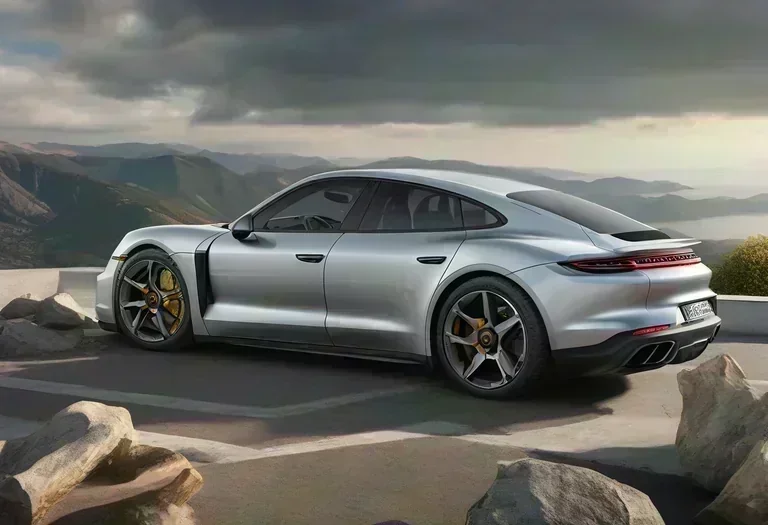
The Porsche Taycan Turbo GT is the cleanest example. Porsche lists its regular output at 778 hp, but engage Launch Control and that climbs to 1,019 hp. Maximum Overboost then briefly unlocks 1,093 hp, a peak figure available for only about two seconds. That is not a misprint or a marketing trick. It is the honest result of an electric drivetrain that can dump enormous current through its motors for an instant before heat forces a retreat.
The reason this surprises people is that combustion cars hide the same truth better. An internal-combustion engine’s peak is usually a figure it can hold for a few seconds on a dyno anyway, so buyers rarely noticed the difference. An EV makes the contrast impossible to ignore because the peak is so dramatic and the fall-off is so sharp.
How Do EVs Measure Power?
Porsche says its quoted Taycan outputs follow UN Global Technical Regulation No. 21 (GTR 21), the standardized method for determining the combined system power of electrified vehicles. On a single-motor car this is simple. On a dual-motor or triple-motor car it is not, because the front and rear axles rarely hit their individual maximums at the same moment under real conditions.
GTR 21 exists precisely to stop manufacturers from adding every motor’s maximum and calling it the total. It forces a measured, repeatable combined figure. That is the number you see in the headline, and it is a legitimate figure. The catch is that GTR 21 system power is not the same as continuous power.
Electric motors can swallow huge current and make enormous power for a moment, then heat becomes the limit. Battery temperature, state of charge, the inverter, the motor and the cooling system all decide how long the party lasts. The combined-power test captures the peak; it says almost nothing about endurance.
What About Sustained Output?
This gap is why a second number exists. UN Regulation 85 (ECE R85) defines an electric drivetrain’s maximum 30-minute power, a repeatable measure of the output it can hold on average across half an hour. For the Taycan Turbo GT, that figure is just 220 hp (164 kW).
This number carries real weight in Europe because it is the figure that lands on German registration documents, which is why the paperwork can look shockingly weak next to the advertised spec. A buyer who sees 1,093 hp on the configurator and 220 hp on the papers is not looking at a contradiction. They are looking at two different tests answering two different questions.
Crucially, it does not mean an EV turns into a slug after 30 minutes. It is a standardized regulatory snapshot taken under fixed laboratory conditions, not a forecast of your next autobahn run. The car is not programmed to shut down at the 31st minute. The figure simply describes what the hardware can maintain without the cooling system being overwhelmed.
What Is the Thermal Wall?
The reason sustained power sits so far below peak is physics, not marketing. Heat builds from internal resistance inside the battery cells and from switching losses in the silicon carbide inverters that convert DC power from the pack into the AC the motors demand. When cell temperature crosses a threshold, the vehicle control unit throttles power to protect the pack from permanent damage.
This is the thermal wall that ends a blistering 0-60 sprint but rarely matters in normal driving. Real-world sustained output shifts constantly with speed, ambient temperature, charge level and thermal management strategy. A cold day and a full battery let the car hold more; a hot track session and a depleted pack force it to back off sooner.
Porsche’s obsessive cooling work, including the track-focused Manthey kit, is less about chasing a bigger peak number and more about protecting the area under the power curve over a long lap. A hypercar that makes 1,900 hp for one launch and then melts is less useful on a circuit than a sedan that holds 800 hp for the full stint. Endurance, not the headline, is what engineers are really fighting for.
Did Petrol Cars Play the Same Game?
EVs did not invent temporary horsepower. Plenty of combustion cars shipped overboost features that delivered brief spikes above their rated output, usually for overtaking. The Ford Fiesta ST of the mid-2010s was rated at 180 hp in Europe but 197 hp in the United States despite carrying essentially the same engine, because US rules let Ford advertise the overboost figure where Europe did not.
The difference is one of degree. A turbo engine might gain 10 or 15 percent for a few seconds. An EV can gain 400 percent. So the old trick was a rounding error next to the new one, which is why the conversation feels new even though the principle is old. Buyers who remember overboost will recognize the pattern; buyers who grew up on electric specs meet it for the first time here.
Why the Gap Matters to Buyers
For most owners the peak-versus-sustained divide is irrelevant. Daily driving never asks a car to hold maximum output for thirty minutes, and a 0-60 launch needs only a couple of seconds of the good stuff. The headline number is the one that shows up in your memory when you press the pedal, and that is the honest experience of the car.
It matters most for a narrow group: track-day regulars, hypercar owners, and anyone towing heavy loads up long grades. Those use cases can genuinely exceed what the thermal system can shed, and for them the sustained figure is the more truthful spec. Everyone else is buying the peak and living the average, which is fine as long as the expectation is set correctly.
How Cooling Changes the Math
Because heat is the enemy, cooling capacity is the real horsepower multiplier. A larger radiator, a more aggressive pump schedule, or a track mode that pre-cools the pack before you arrive can extend how long peak holds by a meaningful margin. This is why performance EVs increasingly ship with active thermal management that begins conditioning the battery the moment you select a sport mode.
The Hyundai Ioniq 5 N tells the same story from the mainstream end. Its peak is 641 hp (478 kW), yet its ECE R85 sustained figure is 213 hp (159 kW). The ratio is nearly identical to the Taycan’s, which tells you this is not a Porsche quirk but a property of lithium-ion chemistry itself. Every EV lives on the same curve; only the cooling budget moves the line.
Specifications
| Specification | Value |
|---|---|
| Porsche Taycan Turbo GT peak output | 1,093 hp (815 kW) |
| Porsche Taycan Turbo GT sustained output (ECE R85) | 220 hp (164 kW) |
| Hyundai Ioniq 5 N peak output | 641 hp (478 kW) |
| Hyundai Ioniq 5 N sustained output (ECE R85) | 213 hp (159 kW) |
Frequently Asked Questions
Q: What is the difference between peak and sustained power in an EV?
A: Peak power is the maximum output an EV can produce, usually for a few seconds, while sustained power is what it can hold over a longer window such as the 30-minute ECE R85 test. The first sells the car; the second reflects thermal reality.
Q: How do manufacturers measure EV power output?
A: They use standardized methods including GTR 21 for combined system power and ECE R85 for maximum 30-minute power. GTR 21 captures the headline number, while ECE R85 captures the output the drivetrain can actually maintain.
Q: Does an EV become slow after 30 minutes?
A: No. The 30-minute figure is a regulatory measurement under fixed conditions, not a cliff your car falls off. In everyday driving you rarely demand continuous peak output, so the real-world experience is far stronger than the 220 hp paperwork suggests.
Q: Did combustion cars also have temporary power figures?
A: Yes. Turbocharged engines offered overboost for short bursts, such as the Ford Fiesta ST’s 197 hp US rating versus 180 hp in Europe. The effect was smaller, so it drew far less attention than the dramatic peaks of modern EVs.