Kia PV7 Electric Van Takes Aim at Ford Transit with Futuristic Styling
Kia's new electric van, the PV7, is set to debut at the IAA Transportation show in September, boasting a futuristic design and targeting the upper end of the midsize van segment.
Key Takeaways
- The Kia PV7 is the brand’s next large electric PBV and will make its world premiere at IAA Transportation in Hannover on September 14, 2026.
- Positioned above the PV5, the PV7 is designed to provide substantially more interior and cargo space for commercial, passenger, recreational, and specialized applications.
- The PV7 uses Kia’s dedicated E-GMP.S architecture, a flexible electric platform developed specifically for purpose-built commercial vehicles and different body configurations.
- Kia’s PBV strategy is built around flexible vehicle configurations, software-based fleet solutions, and conversion possibilities rather than a single fixed van body.
- Kia has previously identified the PV7 as a large PBV and plans to manufacture it at the Hwaseong EVO Plant in Korea from 2027.
- The latest teaser confirms the PV7’s one-box body, distinctive Kia lighting signatures, black hood and pillar treatments, and a design aimed at both business and lifestyle use.
- Detailed battery capacity, range, charging performance, power output, cargo volume, payload, dimensions, and pricing are still to be fully disclosed.
What Makes the Kia PV7 Unique?
The Kia PV7 is set to become one of the most important additions to Kia’s electric commercial-vehicle strategy. Rather than simply adapting a conventional gasoline or diesel van to electric power, Kia has developed the PV7 as part of its dedicated Platform Beyond Vehicle, or PBV, program.
The PV7 follows the PV5 but moves into a larger class, giving Kia a vehicle designed for customers who need significantly more space. The company describes it as a large PBV, while its broader lineup is intended to cover everything from logistics and ride-hailing to passenger transportation and personal lifestyle applications.
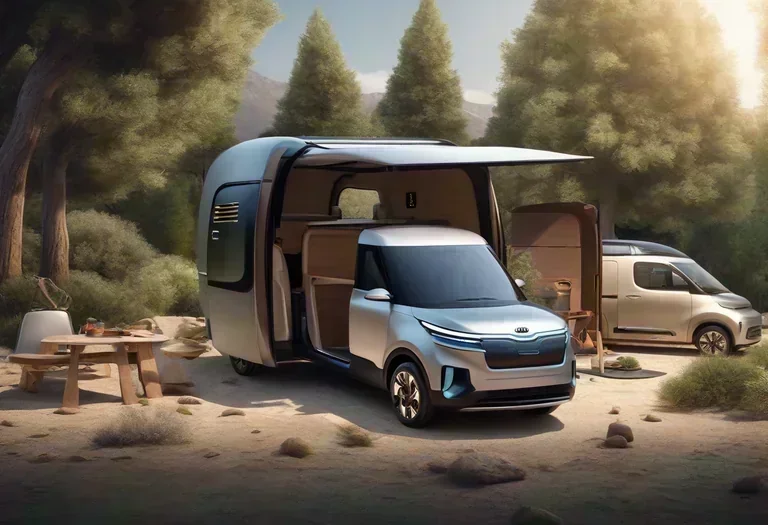
Visually, the production PV7 retains the futuristic design language established by Kia’s earlier PBV concepts. The latest teaser images show a clean one-box silhouette with strong proportions, a contrasting black hood and pillars, and distinctive front and rear lighting signatures. These details help the PV7 look more like a modern electric vehicle than a traditional commercial van.
The design is also intended to support practical use. A long, spacious body allows Kia to offer multiple interior layouts and conversion possibilities. Depending on the market and application, the same underlying vehicle architecture could potentially support cargo, passenger, shuttle, recreational, and other specialized configurations.
This flexibility is central to the PBV concept. Kia is not treating the PV7 simply as one electric van. Instead, the vehicle is being developed as a platform that can support different upper bodies, equipment packages, software services, and business applications.
How Large Is the Kia PV7?
The PV7 sits above the PV5 in Kia’s PBV hierarchy and is intended to provide substantially greater usable space. Kia’s earlier PV7 development concept measured 5,270 mm, or approximately 207.5 inches, in length. The final production vehicle’s complete dimensions and cargo specifications are expected to be confirmed around its world premiere.
That size puts the PV7 into a useful position between conventional midsize commercial vans and the largest full-size electric vans. The exact comparison will depend on body style, wheelbase, roof height, and market specification, but the PV7’s overall proportions make it suitable for businesses that have outgrown a smaller van without necessarily requiring the footprint of the biggest commercial vehicles.
The larger dimensions also give Kia more freedom to create different interior layouts. For cargo operators, additional volume can improve delivery efficiency. Passenger versions could accommodate more occupants, while recreational conversions could take advantage of the long floor area and electric architecture.
One of the biggest advantages of a dedicated EV commercial platform is the ability to package the battery and electric hardware beneath the vehicle rather than building around a large conventional engine and transmission. Kia’s E-GMP.S architecture was created with this type of flexibility in mind.
What Is Kia’s E-GMP.S Platform?
The Kia PV7 is built on E-GMP.S, the company’s dedicated platform for Platform Beyond Vehicle models. Although the name is related to Kia and Hyundai Motor Group’s broader E-GMP electric-vehicle architecture, E-GMP.S has been developed specifically for the requirements of PBVs and light commercial vehicles.
Unlike a traditional van platform that may be tied closely to one body style, E-GMP.S is designed to accommodate different vehicle configurations. Kia has highlighted its flexibility for applications such as cargo vehicles, passenger models, and chassis-cab derivatives.
The architecture is particularly important for the PV7 because commercial customers rarely have identical requirements. A parcel-delivery company, airport shuttle operator, camper-van converter, and tradesperson can all need completely different vehicles even if they start with the same basic platform.
The electric architecture also provides packaging benefits. Removing the traditional center tunnel and using an EV-oriented floor layout creates more opportunities for designers to maximize interior space. For a commercial vehicle, that can translate into easier loading, more flexible seating arrangements, and greater freedom for conversion specialists.
Kia’s PBV strategy extends beyond the hardware. The company is also developing software, connectivity, fleet-management capabilities, charging solutions, and other services intended to make its PBVs part of a broader business ecosystem.
How Will the Kia PV7 Be Used?
The PV7’s size makes it particularly relevant to commercial operators, but Kia is also emphasizing private and recreational applications. The company’s PBV strategy is designed around the idea that one vehicle platform can serve many different customers.
For businesses, the PV7 could be configured for delivery work, transportation services, mobile businesses, fleet operations, or passenger movement. Its larger footprint compared with the PV5 gives conversion partners more room to install specialized equipment without compromising basic usability.
The recreational potential is equally significant. Kia’s PV5 program already demonstrates the company’s interest in lifestyle-focused conversions, including camper-oriented configurations. The larger PV7 could offer substantially more room for sleeping areas, storage, seating, cooking equipment, or other recreational hardware.
Teaser imagery showing the PV7 in lifestyle settings reinforces that broader positioning. Kia is clearly presenting the vehicle as something more versatile than a conventional work van.
That approach could become one of the PV7’s biggest differentiators. Traditional commercial vans are often designed first around a fixed cargo or passenger configuration, with conversions added later. Kia’s PBV strategy instead places adaptability at the center of the vehicle’s development.
What Do We Know About the Kia PV7 Powertrain?
The Kia PV7 is a fully electric vehicle, but Kia has not yet released the complete production powertrain specification. That means key figures such as battery capacity, electric-motor output, driving range, payload, charging time, and energy consumption should not yet be treated as final.
Kia’s dedicated PBV platform does provide some clues about the vehicle’s engineering priorities. E-GMP.S was developed around electric commercial vehicles and is designed to support multiple vehicle sizes and body configurations.
Kia has also previously stated that its PBV models will benefit from the advantages of dedicated electric architecture, including flexible packaging and compatibility with different commercial applications. The company has emphasized charging, software connectivity, fleet management, and over-the-air functionality as important elements of its PBV strategy.
For commercial customers, the final battery and charging specifications will be especially important. A delivery fleet needs predictable range and fast turnaround times, while a passenger shuttle may prioritize daily operating efficiency. Recreational users, meanwhile, may value battery capacity and electrical flexibility differently.
Those specifications are expected to become much clearer when the production PV7 makes its official debut.
How Does the Kia PV7 Compare With Other Electric Vans?
The PV7 enters a competitive commercial-vehicle market that already includes electric versions of established vans from manufacturers such as Ford, Mercedes-Benz, Volkswagen, Renault, and other major automakers.
Its positioning is particularly interesting because the PV7 occupies the space between smaller midsize vans and larger commercial vehicles. Long-wheelbase versions of models such as the Ford Transit Custom and Mercedes-Benz Vito provide a useful point of comparison, while larger vehicles such as the Ford E-Transit demonstrate what customers can expect when moving into the full-size van category.
The PV7’s main advantage may not be outright size. Instead, Kia is betting on the combination of electric architecture, modern design, configurable body styles, software services, and conversion potential.
Established van manufacturers have decades of experience with commercial fleets, so Kia will need to demonstrate competitive operating costs, reliability, charging capability, payload, cargo capacity, service support, and residual values. The PV7’s success will depend on whether its technology and flexibility translate into tangible benefits for businesses.
Its modern appearance could also help Kia attract customers who want an electric commercial vehicle that feels more like a next-generation product than an electrified version of an older van.
When Will the Kia PV7 Go on Sale?
Kia has previously outlined a 2027 launch timeline for the PV7, following the introduction of the PV5. The company’s longer-term PBV plan calls for a three-model lineup consisting of the PV5, PV7, and PV9, with the PV9 planned for 2029.
Kia has also confirmed that production of the PV7 is planned at the Hwaseong EVO Plant in South Korea. The facility was developed specifically to support Kia’s growing PBV business and uses a flexible production approach intended to accommodate different vehicle configurations.
The PV7’s world premiere will take place at IAA Transportation in Hannover, Germany, on September 14, 2026, giving Kia an opportunity to reveal the production vehicle to the global commercial-vehicle industry.
The timing is significant because Kia is targeting major growth in the electric light-commercial-vehicle market. The company has set a goal of selling 250,000 PBVs globally by 2030, with the PV5, PV7, and later PV9 forming the core of the lineup.
What Does the Kia PV7 Mean for the Electric Van Market?
The PV7 represents a broader shift in how automakers are approaching electric commercial vehicles. Instead of simply replacing an internal-combustion engine with an electric motor, Kia is developing a dedicated ecosystem around the vehicle.
That ecosystem includes the vehicle itself, charging, software, fleet-management systems, conversion partnerships, and specialized services. For fleet operators, these technologies could become as important as the van’s basic range or payload.
The PV7 also demonstrates why dedicated electric commercial platforms can be useful. A flat and flexible architecture can make it easier to create different body styles while preserving a common underlying vehicle platform.
If Kia can deliver competitive range, charging performance, cargo capacity, payload, pricing, and commercial support, the PV7 could become an important alternative to established European electric vans. Its ability to serve both business and recreational customers could further expand its potential market.
The most important details remain to be confirmed, but the PV7’s combination of large dimensions, dedicated EV architecture, flexible conversion potential, and distinctive styling makes its 2026 debut one of the more significant developments in Kia’s commercial-vehicle strategy.
Conclusion
The Kia PV7 is shaping up to be a major step in the expansion of Kia’s electric PBV lineup. Larger and more versatile than the PV5, it is designed around the needs of commercial operators while leaving room for passenger, recreational, and specialized conversions.
Its E-GMP.S architecture gives Kia a foundation for flexible vehicle configurations, while the company’s emphasis on software and fleet solutions could differentiate the PV7 from conventional electric vans.
Although the final battery, range, power, payload, cargo volume, and pricing figures are still to be announced, the PV7’s 5,270-mm development-concept length and large-PBV positioning show that it will target customers who need considerably more space than the PV5 can provide.
With its world premiere scheduled for September 14, 2026, the Kia PV7 is entering the market at a time when electric vans are becoming increasingly important for both commercial fleets and private users. The production reveal should provide the definitive answers on whether Kia can turn its ambitious PBV concept into a serious competitor in the global electric-van market.
Kia PV7 Specifications
| Specification | Kia PV7 |
|---|---|
| Vehicle type | Large electric PBV / light commercial vehicle |
| Powertrain | Fully electric |
| Platform | Kia E-GMP.S dedicated PBV architecture |
| Development concept length | 5,270 mm (207.5 in) |
| Position in PBV lineup | Above PV5 and below planned PV9 |
| Body philosophy | Flexible platform designed for multiple commercial and lifestyle applications |
| Potential applications | Cargo, passenger transport, shuttle, logistics, recreational and specialized conversions |
| Production location | Hwaseong EVO Plant, South Korea |
| Planned production timing | 2027 |
| World premiere | IAA Transportation, Hannover, September 14, 2026 |
| Battery capacity | Not yet announced |
| Electric motor output | Not yet announced |
| Driving range | Not yet announced |
| Charging performance | Not yet announced for the production PV7 |
| Payload | Not yet announced |
| Cargo volume | Not yet announced |
| Price | Not yet announced |
Frequently Asked Questions
Q: When will the Kia PV7 debut?
A: The Kia PV7 will make its world premiere at IAA Transportation in Hannover, Germany, on September 14, 2026. The public exhibition runs from September 15 through September 20.
Q: Is the Kia PV7 fully electric?
A: Yes. The PV7 is a fully electric PBV and is built on Kia’s E-GMP.S architecture, which was developed specifically for electric purpose-built vehicles and commercial applications.
Q: How large is the Kia PV7?
A: Kia’s earlier PV7 development concept measured 5,270 mm (207.5 inches) long. Final production dimensions and wheelbase specifications have not yet been fully released.
Q: Is the Kia PV7 larger than the PV5?
A: Yes. The PV7 is positioned above the PV5 in Kia’s PBV lineup and is designed to provide more interior and cargo space for larger commercial and lifestyle applications.
Q: What is the Kia PV7 platform?
A: The PV7 uses Kia’s E-GMP.S platform, a dedicated PBV architecture designed to support different vehicle sizes, body styles, commercial applications, and conversion possibilities.
Q: What will the Kia PV7 be used for?
A: The PV7 is being developed for a broad range of uses, including cargo and logistics operations, passenger transportation, shuttle services, business applications, recreational vehicles, and specialized conversions.
Q: What is the Kia PV7’s battery capacity?
A: Kia has not yet announced the final production battery capacity for the PV7. Detailed battery, range, power, and charging specifications are expected to be revealed as the vehicle moves toward its official launch.
Q: How much range will the Kia PV7 have?
A: The official driving range has not yet been announced. The final figure will depend on the production battery, motor configuration, body style, payload, and market-specific testing requirements.
Q: When will Kia start producing the PV7?
A: Kia has previously planned PV7 production for 2027 at its Hwaseong EVO Plant in South Korea. The PV7 is scheduled to follow the PV5 in Kia’s dedicated PBV expansion.
Q: Will there be different Kia PV7 versions?
A: Kia’s PBV strategy is specifically designed around multiple body types and conversion possibilities. The company has not yet announced the complete production PV7 derivative lineup, but the E-GMP.S architecture is designed to support a wide range of applications.
Q: What other vehicles will compete with the Kia PV7?
A: The PV7 will enter a market that includes electric commercial vans such as the Ford E-Transit and electric versions of midsize vans from manufacturers including Ford and Mercedes-Benz. Its final positioning will become clearer once Kia releases complete production specifications and pricing.