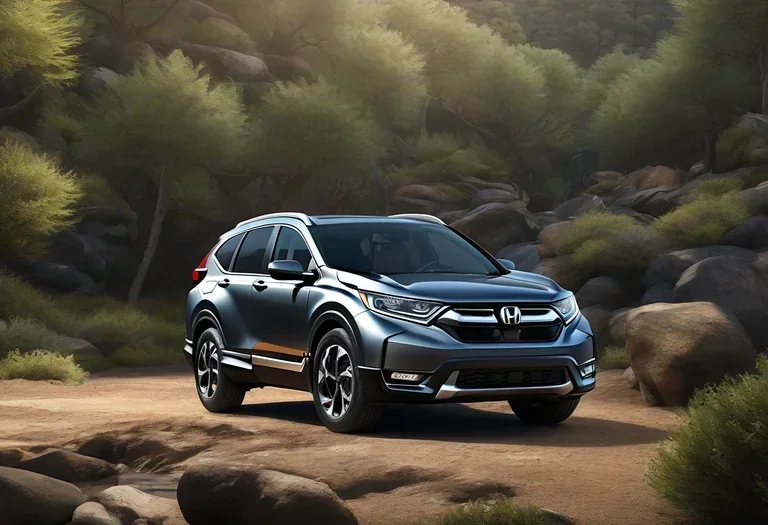
2026 Honda CR-V e:HEV: Hybrid Power, Fuel Economy, AWD and Specs
The Honda CR-V e:HEV combines a 2.0-liter engine with Honda's two-motor hybrid system. Here's what to know about power, fuel economy, AWD, features and specs.
Key Takeaways
- The Honda CR-V e:HEV is a hybrid midsize SUV built around a 2.0-liter naturally aspirated four-cylinder engine and Honda’s two-motor hybrid system.
- Depending on the market and trim, the CR-V e:HEV is available with front-wheel drive or all-wheel drive.
- The hybrid system produces up to 135 kW (181 hp) and 335 Nm (247 lb-ft) in markets using those specifications.
- Honda’s e:HEV system uses electric drive extensively, with the petrol engine able to generate electricity or drive the wheels directly under certain conditions.
- Higher-spec CR-V hybrid models can get features such as a 9-inch infotainment display, wireless Apple CarPlay and Android Auto, and a 12-speaker Bose premium audio system.
- The CR-V e:HEV is tuned more for quiet, efficient everyday driving than outright performance.
What Is the Honda CR-V e:HEV?
The Honda CR-V e:HEV is the hybrid version of Honda’s current CR-V, and the basic formula is pretty simple: take a practical midsize SUV, add Honda’s two-motor hybrid system and let the electric side of the powertrain do a lot of the work.
I’ve been around cars for 30 years, and this is the kind of hybrid setup that makes sense in a vehicle like the CR-V.
You don’t need a complicated powertrain just for the sake of having one. You need something that is smooth in traffic, economical around town, quiet on the highway and reliable enough that the owner doesn’t have to think about it every five minutes.
That’s what Honda is chasing here.
The CR-V e:HEV uses a 2.0-liter naturally aspirated four-cylinder petrol engine with two electric motors and Honda’s electronically controlled continuously variable transmission system. Honda describes the architecture as a two-motor hybrid system.
How Does the Honda CR-V e:HEV Hybrid System Work?
This isn’t simply a petrol engine with a small electric motor bolted onto it.
Honda’s two-motor hybrid system can operate in different ways depending on speed and load. In many situations, the petrol engine acts as a generator while an electric motor drives the wheels. Under other conditions, the engine can be mechanically connected to the wheels.
That’s why the CR-V e:HEV doesn’t behave exactly like a conventional petrol car with an automatic transmission.
At lower speeds and around town, the electric motor can provide the immediate response you expect from an EV. The petrol engine can then run in the background to provide energy to the system.
At higher speeds, when the engine is operating efficiently, Honda can use the engine to drive the wheels directly.
It’s a clever system because the engine doesn’t have to do everything all the time.
And that’s really the point of a hybrid.
How Much Power Does the Honda CR-V e:HEV Make?
In markets where the 135 kW specification applies, the CR-V e:HEV produces 135 kW (181 hp) and 335 Nm (247 lb-ft).
Those are respectable numbers for a family SUV, but don’t read them like you’re looking at the specifications of a sports car.
The 335 Nm figure is more important in everyday driving because electric motors deliver their torque quickly. That gives the CR-V a responsive feel when pulling away from a stop or accelerating into traffic.
The system is designed around smoothness and efficiency rather than trying to make the CR-V feel like a performance SUV.
That’s the right choice.
Honda doesn’t need the CR-V to scare you. It needs it to make the daily commute boring in the best possible way.
Is the Honda CR-V e:HEV Available With AWD?
Yes, depending on the market and trim level.
Honda offers the CR-V hybrid with front-wheel drive in some configurations and all-wheel drive in others. The exact combination of trim names and drivetrain availability varies by country.
That’s important when shopping for one because you can’t assume that a CR-V e:HEV sold in one country has exactly the same drivetrain lineup as one sold somewhere else.
For example, Honda’s North American 2026 CR-V specifications show two-motor hybrid versions with both 2WD and AWD configurations.
AWD adds traction, but let’s keep this in perspective. The CR-V is still a road-focused family SUV. It isn’t a body-on-frame off-roader, and nobody should buy one expecting it to behave like one.
What Is the Honda CR-V e:HEV Like to Drive?
The CR-V e:HEV is at its best when you’re not trying to drive it like a sports car.
It’s quiet, smooth and predictable. The electric motor provides the immediate response that makes a hybrid feel good in stop-and-go traffic, while the petrol engine handles the longer-running duties when required.
That’s particularly useful in city driving.
You get repeated acceleration, braking and low-speed operation, which is exactly where a hybrid can make good use of electric propulsion and regenerative braking.
On the highway, the system settles down and the engine can operate in the part of its efficiency range where it makes the most sense.
The suspension uses MacPherson struts at the front and a multi-link arrangement at the rear. That gives the CR-V a good balance between ride comfort and body control.
It isn’t a sports SUV, but it doesn’t need to be.
The steering is predictable, the body stays reasonably controlled through corners and the whole thing feels engineered around real-world driving rather than a spec-sheet battle.
How Fuel Efficient Is the Honda CR-V e:HEV?
This is where the hybrid earns its keep.
Fuel economy varies by market, drivetrain, wheels, equipment and testing procedure, so there isn’t one global CR-V e:HEV fuel-economy number that applies everywhere.
As one example, Honda’s 2026 U.S. specifications list the two-wheel-drive hybrid at 43 mpg city, 36 mpg highway and 40 mpg combined, while AWD versions are rated lower. That’s roughly 5.9 L/100 km for the 2WD combined figure under the U.S. EPA test cycle.
Other markets use different testing procedures and publish different numbers.
That’s why I wouldn’t compare a European, Asian, Australian and American CR-V fuel-economy number without checking the test standard first.
The takeaway is simpler: the CR-V e:HEV is designed to use considerably less fuel than a comparable conventional petrol SUV, particularly in the kind of mixed urban driving where the hybrid system gets to do its thing.
What’s Inside the Honda CR-V e:HEV?
The CR-V’s interior is one of the reasons this SUV has become such a strong seller.
It’s spacious, straightforward and practical rather than trying too hard to look futuristic.
Higher-grade versions can be equipped with a 9-inch touchscreen, wireless Apple CarPlay and Android Auto, wireless charging and a 12-speaker Bose premium audio system. Honda’s current specifications list those features depending on trim.
The Bose system was developed specifically for the CR-V cabin and uses 12 speakers, including a subwoofer.
That’s the kind of equipment buyers notice after six months of ownership.
Not how dramatic the dashboard looked in the brochure.
Whether you’re commuting, taking the kids to school or spending six hours on the highway, the things that matter are space, visibility, comfort, storage and a decent interface.
The CR-V generally gets those fundamentals right.
Is the Honda CR-V e:HEV Comfortable?
Yes, and comfort is one of the strongest arguments for the hybrid.
The electric drive system makes low-speed operation particularly smooth, while Honda has put plenty of effort into keeping the cabin quiet.
Higher trims can also add features such as leather-trimmed seating, power-adjustable front seats, heated seats, a panoramic roof and premium audio, although the exact equipment depends on the market.
That’s the thing to remember with the CR-V: Honda sells the same basic vehicle in a lot of different countries, but equipment isn’t universal.
Don’t assume that a feature you saw on a top-spec CR-V overseas is included on the version sitting at your local dealer.
How Practical Is the Honda CR-V e:HEV?
This is where the CR-V makes the most sense.
It’s a family SUV first.
There’s room for five people, useful cargo capacity and a rear seat designed around actual passengers rather than just being an emergency bench.
Honda’s 2026 U.S. specifications list up to 39.3 cubic feet of cargo space behind the rear seats in some configurations and up to 76.5 cubic feet with the rear seats folded. The exact figures vary by drivetrain and trim.
That’s enough space to make the CR-V useful without stepping up to a much larger SUV.
And that’s probably the biggest reason these things sell.
You don’t need to explain a CR-V to anybody.
It carries people. It carries stuff. It doesn’t drink fuel like a truck. It drives easily in traffic. And if you get the AWD version, you have extra traction when conditions get ugly.
What Are the Honda CR-V e:HEV’s Main Drawbacks?
The CR-V e:HEV isn’t perfect.
First, the hybrid system is built for efficiency and smoothness, not driver involvement. If you want the mechanical feel of a conventional transmission and a big petrol engine, this isn’t that vehicle.
The engine can also get noticeably louder when you demand maximum acceleration. That’s normal for this type of hybrid system, but some drivers won’t like the change in engine note.
Second, trim availability varies dramatically between markets. A feature-rich CR-V in one country can have a very different equipment list from one sold somewhere else.
And third, the top trims can get expensive once you start adding the equipment most buyers actually want.
That’s not unique to Honda. It’s just the reality of the modern SUV market.
Honda CR-V e:HEV Specifications
| Specification | Honda CR-V e:HEV |
|---|---|
| Engine | 2.0-liter naturally aspirated four-cylinder petrol |
| Hybrid system | Honda two-motor hybrid system |
| Transmission | e-CVT / electronically controlled hybrid transmission, depending on market terminology |
| System power | Up to 135 kW (181 hp), depending on market |
| System torque | Up to 335 Nm (247 lb-ft), depending on market |
| Drive | FWD or AWD, depending on market and trim |
| Infotainment | 9-inch display available |
| Smartphone integration | Wireless Apple CarPlay and Android Auto available |
| Premium audio | 12-speaker Bose system available on higher trims |
| Seating | 5 |
Honda CR-V e:HEV Pros and Cons
Pros
- Smooth two-motor hybrid system
- Strong low-speed response from the electric motor
- Good fuel economy for a midsize SUV
- Spacious and practical interior
- Available all-wheel drive
- Quiet and comfortable on everyday roads
- Good technology and premium features on higher trims
Cons
- Not particularly exciting to drive
- Engine noise can become obvious under hard acceleration
- Top trims can get expensive
- Equipment and drivetrain availability vary considerably by market
- Hybrid specifications and fuel-economy figures aren’t directly comparable across countries because testing standards differ
The Bottom Line on the Honda CR-V e:HEV
The Honda CR-V e:HEV isn’t trying to be the fastest hybrid SUV on the road.
Good.
That’s not what most CR-V buyers need.
What Honda has built is a sensible hybrid system wrapped in one of the company’s most practical vehicles.
The two-motor setup gives the CR-V smooth electric response around town, while the 2.0-liter petrol engine provides the range and flexibility you expect from a conventional vehicle.
Add available AWD, a roomy cabin and useful technology, and you’ve got a package that makes sense for people who actually have to live with their vehicle every day.
After 30 years around cars, that’s what I look for first.
Not whether something has the biggest number in the brochure.
Does it work?
The CR-V e:HEV does.
Frequently Asked Questions About the Honda CR-V e:HEV
What is the Honda CR-V e:HEV?
The Honda CR-V e:HEV is the hybrid version of the CR-V. It uses a 2.0-liter petrol engine and Honda’s two-motor hybrid system to provide electric-assisted propulsion and improved fuel efficiency.
How does the Honda CR-V e:HEV work?
Honda’s two-motor hybrid system can use the petrol engine to generate electricity for the electric drive system, while under other conditions the engine can mechanically drive the wheels. The system changes operating mode according to vehicle speed and driving conditions.
How much horsepower does the Honda CR-V e:HEV have?
In markets using Honda’s 135 kW specification, the CR-V e:HEV produces 135 kW, equivalent to 181 hp. Specifications vary by market.
How much torque does the Honda CR-V e:HEV have?
The CR-V e:HEV produces up to 335 Nm (247 lb-ft) in markets using that specification.
Does the Honda CR-V e:HEV have AWD?
Yes. Honda offers the CR-V hybrid with all-wheel drive in selected markets and trim levels. Other versions are front-wheel drive.
What is the Honda CR-V e:HEV fuel economy?
Fuel economy depends on the market, drivetrain, trim and testing procedure. For example, Honda’s 2026 U.S. specifications rate the 2WD hybrid at 40 mpg combined under the EPA test cycle, while AWD versions are rated lower.
Does the Honda CR-V e:HEV have Apple CarPlay and Android Auto?
Higher-specification CR-V models offer wireless Apple CarPlay and Android Auto. Equipment varies by market and trim.
Does the Honda CR-V e:HEV have a Bose sound system?
Yes, a 12-speaker Bose premium audio system is available on higher-specification CR-V models in selected markets.
Is the Honda CR-V e:HEV a good family SUV?
Yes. Its biggest strengths are the smooth hybrid powertrain, useful fuel economy, roomy interior, comfortable ride and available AWD. It’s built more for everyday family use than outright performance.