Mazda 767B Catches Fire at Laguna Seca, But Historic Racer Will Be Restored
The historic 1990 Le Mans class winner will be restored.
Key Takeaways
- The No. 203 Mazda 767B caught fire at Laguna Seca during the 2026 Monterey Pre-Reunion.
- Nobody was injured, and the fire was extinguished before the historic prototype was destroyed.
- Ghost Riders, the team campaigning the car, says chassis 203 will be restored and returned to the track.
- The 767B has genuine Le Mans history, finishing 20th overall and winning the IMSA GTP class at the 1990 24 Hours of Le Mans.
- The car is particularly significant because it is one of Mazda’s surviving four-rotor Group C prototypes.
- The exact cause of the fire and the full extent of the damage have not been publicly disclosed.
What Happened to the Mazda 767B at Laguna Seca?
There are few sounds in motorsport quite like a Mazda four-rotor rotary engine at full song. That is what makes seeing one of these historic prototypes engulfed in flames particularly difficult for anyone who appreciates racing history.
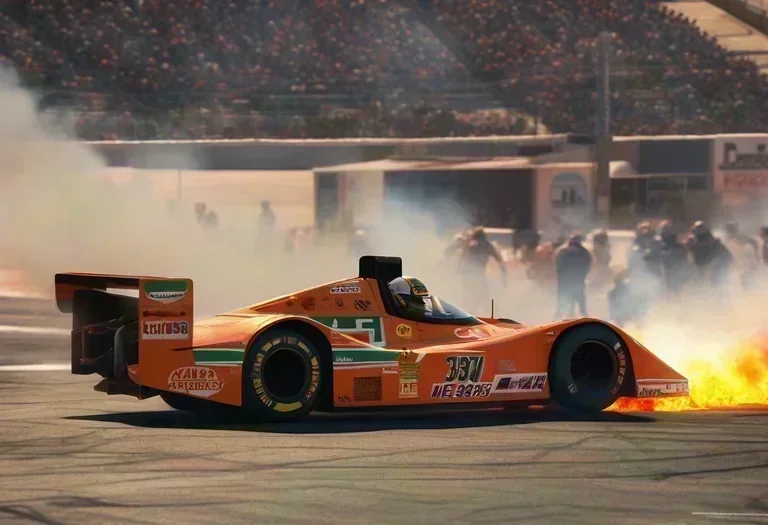
The No. 203 Mazda 767B caught fire during the Monterey Pre-Reunion at WeatherTech Raceway Laguna Seca on August 10, shortly before the Rolex Monterey Motorsports Reunion.
Video from the incident shows flames coming from the rear section of the orange-and-green prototype as crew members moved quickly to attack the fire with extinguishers.
The fire was brought under control, and most importantly, nobody was injured.
The car was not able to continue participating in the Monterey events, however. Ghost Riders, the team responsible for campaigning the 767B, subsequently confirmed that the car would miss the remaining activity while repairs are undertaken.
The Monterey Pre-Reunion is specifically intended to give owners of historic competition cars additional track time before the main Rolex Monterey Motorsports Reunion. More than 300 historic race cars were scheduled to participate in the August 8-9 event, making it one of the most important gatherings of historic racing machinery in North America.
The official WeatherTech Raceway Laguna Seca website lists the Monterey Pre-Reunion as part of the track’s annual Monterey Car Week schedule.
Is This the Mazda 787B That Won Le Mans?
No, and that distinction is important.
The car involved in the fire is a Mazda 767B, not the famous Mazda 787B that won the 24 Hours of Le Mans outright in 1991.
The 787B has become one of the most recognizable racing cars ever produced, thanks largely to its spectacular orange-and-green Renown livery and screaming four-rotor engine. Mazda is bringing the actual 1991 Le Mans-winning 787B to the 2026 Rolex Monterey Motorsports Reunion, along with several other important cars from its racing history.
Mazda’s own historical record confirms that the winning 787B is a separate car from the 767B that suffered the fire.
That distinction doesn’t make the damaged car unimportant.
Far from it.
The No. 203 767B has its own legitimate place in Mazda’s Le Mans story. At the 1990 24 Hours of Le Mans, it finished 20th overall and won the IMSA GTP class.
In fact, it was the only one of Mazda’s three entries that finished the race that year.
Mazda’s official Le Mans history records the No. 203 767B as the GTP class winner in 1990, finishing ahead of the newer Mazda 787s that had been introduced for that season.
You can see the manufacturer’s complete Mazda Le Mans racing history for the 767B, 787 and 787B.
Why Is the Mazda 767B So Important?
The 767B sits in one of the most interesting periods of Mazda’s endurance-racing development.
The car evolved from the Mazda 767, which itself followed the earlier 757 prototype. Mazda was developing increasingly sophisticated four-rotor rotary engines as it tried to compete with some of the most powerful and technically advanced sports prototypes of the Group C era.
The 767B used a four-rotor 13J rotary engine and competed under IMSA’s GTP regulations at Le Mans.
By modern standards, the concept sounds almost ridiculous: a compact four-rotor naturally aspirated Wankel engine producing enormous power, installed in a lightweight prototype and asked to run for 24 hours at racing speeds.
Yet Mazda made it work.
The 767B was not the car that finally delivered Mazda’s overall Le Mans victory, but it was an important step toward that achievement.
In 1989, Mazda’s 767Bs finished seventh and ninth overall at Le Mans, while another Mazda 767 finished 12th.
For 1990, Mazda introduced the newer 787, but the new cars suffered problems that prevented either from finishing. That left the older No. 203 767B to carry Mazda’s flag to the finish.
It finished 20th overall and first in the GTP class.
A year later, Mazda would return with the 787B and make history by winning Le Mans outright.
What Makes Chassis 203 Different From the 787B?
The easiest mistake to make when looking at Mazda’s historic Group C cars is to treat every orange-and-green rotary prototype as the same machine.
They aren’t.
The 767B predates the 787B and represents an earlier stage in Mazda’s development of its four-rotor endurance-racing technology.
The 767B used the 13J family of four-rotor engines, while the 787 and 787B moved to Mazda’s more advanced R26B four-rotor engine.
The newer engine was lighter, more compact and more efficient, and it ultimately powered the 787B to its famous 1991 victory.
But the 767B remains valuable because it shows how Mazda arrived there.
It was part of the development chain that transformed Mazda from an ambitious Japanese manufacturer competing in international endurance racing into the first and only Japanese manufacturer to win the overall 24 Hours of Le Mans with a rotary-powered car.
That makes a surviving 767B more than an expensive old race car.
It is a physical piece of the story.
How Serious Is the Fire Damage?
At this point, the honest answer is that we don’t know the complete extent of the damage.
Images and video from the incident show a substantial fire at the rear of the car, but the fact that the flames were extinguished relatively quickly is encouraging.
Historic racing cars are often considerably more repairable than modern production vehicles because they were constructed with motorsport service and component replacement in mind.
That does not mean restoration will be easy.
A car like the 767B contains components that are either extremely rare or effectively irreplaceable. Original bodywork, period-correct mechanical parts, instrumentation and other details can be extraordinarily difficult to source.
The rotary engine itself is another major consideration.
Any fire involving the engine bay requires a careful inspection of the engine, wiring, fuel system, plumbing, electronics and surrounding structures before anyone can determine what can be reused.
The good news is that Ghost Riders has already made its position clear: the car will be restored.
Will the Mazda 767B Be Restored?
Yes.
Ghost Riders has confirmed that No. 203 will not continue with the remainder of the Reunion activity, but the team intends to rebuild the car.
That is probably the most important news to come out of the incident.
Historic racing only works when these cars are actually used. Keeping them locked away in climate-controlled collections may preserve them physically, but it also removes the very thing that makes them special.
The 767B was built to race.
It was designed to scream around circuits at high speed, and seeing one run at Laguna Seca allows a new generation of enthusiasts to experience something that cannot be recreated by photographs or museum displays.
There is always risk involved when historic racing machinery is exercised in that environment.
These cars are decades old, often run at high loads and use technology that was developed long before today’s modern electronic monitoring and safety systems.
The fire is an unfortunate reminder of that reality.
Why Does the 767B Still Race at Laguna Seca?
There is a good reason historic prototypes like the 767B continue to appear at events such as the Rolex Monterey Motorsports Reunion.
They are part of automotive history, but they are also remarkably effective at bringing that history to life.
Watching a 767B drive slowly around a display area tells you very little about the machine. Hearing the four-rotor engine accelerate down the straight at Laguna Seca tells you almost everything.
The sound, vibration and speed provide context that static displays cannot.
Laguna Seca is also an appropriate venue for the car. The track’s Corkscrew section is one of the most recognizable corners in American motorsport, and the circuit regularly hosts historic racing machinery from several eras.
The Monterey Motorsports Reunion is specifically built around the idea of returning historically significant cars to competition-style running rather than simply putting them on display.
That philosophy explains why a car worth millions can still be seen being driven hard around a racetrack.
It also explains why incidents like this can happen.
What About Mazda’s Other Historic Race Cars?
The timing of the fire is particularly unfortunate because Mazda has assembled an unusually significant collection of racing machinery for the 2026 Monterey Motorsports Reunion.
Mazda announced that its display would include the 1991 Le Mans-winning 787B, the 1989 767B-002, the 1990 787-002, the 1991 RX-7 GTO, the RX-792P and the RT24-P.
The manufacturer also planned to have drivers demonstrate several of the cars on track.
That means fans attending Monterey Car Week this year have an unusually complete view of Mazda’s motorsport development, from the early rotary-powered cars through its prototype racing programs.
The No. 203 767B was supposed to be part of that story in motion.
Instead, it will now be part of a different story: another historic racing car that needs to be rebuilt so it can return to the circuit.
What Caused the Mazda 767B Fire?
The cause of the fire has not been officially established.
There has been speculation online about possible mechanical or fluid-related causes, but none of those theories should be treated as fact without confirmation from the team or the people responsible for inspecting the car.
That is particularly important with a historic race car.
A fire can originate from numerous sources, including fuel, oil, electrical wiring, hydraulic systems or mechanical failures that release hot fluids into the engine compartment.
Until the car has been examined, identifying one specific cause would be speculation.
For now, the important facts are straightforward: the 767B caught fire, the crew extinguished it, nobody was hurt and the car is scheduled for restoration.
What Happens Next for Mazda 767B #203?
The immediate priority will be assessing the car and determining which components can be saved.
That process can take considerable time with a historic prototype.
The restoration team will need to document the damage before dismantling the affected areas. Components will then have to be inspected individually, with original or period-correct parts preserved wherever possible.
There is also the question of whether the car will return looking exactly as it did before the fire.
For an important historic racing car, authenticity matters. But so does safety.
Anything compromised by heat will need to be repaired or replaced, even if that means using newly manufactured components rather than preserving every original part.
That is the reality of keeping old race cars alive.
The goal is not necessarily to freeze them in time. The goal is to preserve enough of the original car, history and character that the machine can continue to tell its story.
The 767B’s Story Isn’t Over
Seeing Mazda 767B #203 catch fire at Laguna Seca was painful, but this is not the end of the car.
The No. 203 machine has already survived a far more demanding environment than a modern collector car will ever experience. It completed the 24 Hours of Le Mans in 1990, finished 20th overall and won its class while newer Mazda prototypes failed to reach the finish.
It then survived decades of changing ownership, preservation and historic racing.
Now it has another restoration ahead of it.
That is exactly what historic motorsport is about. Cars such as the 767B are too important to be reduced to static artifacts. They need to be preserved, maintained and, when possible, driven.
Ghost Riders says No. 203 will return.
When that four-rotor engine eventually fires again, the sound will mean a little more than it did before.
Frequently Asked Questions
Q: What happened to the Mazda 767B at Laguna Seca?
A: The No. 203 Mazda 767B caught fire during the 2026 Monterey Pre-Reunion at WeatherTech Raceway Laguna Seca. The fire was extinguished, nobody was injured and the car was withdrawn from the remaining Reunion activities.
Q: Was the Mazda 787B that won Le Mans destroyed?
A: No. The car involved in the Laguna Seca fire was a 767B, chassis No. 203. It is not the Mazda 787B that won the 1991 24 Hours of Le Mans.
Q: Did Mazda 767B #203 win Le Mans?
A: No. The No. 203 Mazda 767B finished 20th overall at the 1990 24 Hours of Le Mans but won the IMSA GTP class. Mazda won the overall race the following year with the 787B.
Q: Will Mazda 767B #203 be restored?
A: Yes. Ghost Riders, the team campaigning the car, has said that No. 203 will be restored and returned to the track.
Q: What engine does the Mazda 767B use?
A: The 767B uses Mazda’s four-rotor 13J rotary engine. The later 787 and 787B moved to the more advanced R26B four-rotor engine.
Q: What caused the Mazda 767B fire?
A: The cause has not been officially disclosed. Online speculation about the source of the fire has not been confirmed by the team, so the cause should be considered unknown until an inspection is completed.
Q: When did Mazda win the 24 Hours of Le Mans?
A: Mazda won the 24 Hours of Le Mans outright in 1991 with the Mazda 787B. The No. 203 767B was part of the preceding development story and won the IMSA GTP class at Le Mans in 1990.