Serve Robotics Expands Delivery Robot Fleet with Grubhub and DoorDash
Serve Robotics partners with Grubhub and DoorDash to expand its delivery robot fleet across the US
Key Takeaways
- Serve Robotics is expanding its autonomous food-delivery operations through partnerships with Grubhub and DoorDash.
- The company has more than 2,000 delivery robots operating across the United States.
- Serve Robotics has established its first microdepot in Miami to support its growing autonomous delivery fleet.
- The company works with more than 4,000 restaurants and is expanding its coverage into additional U.S. markets.
- Serve Robotics’ autonomous robots use cameras, sensors and AI-powered software to navigate sidewalks and deliver orders.
- The company’s delivery model is designed to complement restaurant and delivery-platform operations rather than completely replace traditional delivery services.
- Uber has fully divested its stake in Serve Robotics, removing a significant early investor from the company’s shareholder base.
- The expansion highlights the growing role of autonomous delivery robots in the U.S. food-delivery market.
What’s Behind Serve Robotics’ Expansion?
Serve Robotics is accelerating its expansion of autonomous food delivery in the United States as demand for robotic delivery services continues to grow. The company has built partnerships with major delivery platforms including Grubhub and DoorDash, giving its sidewalk robots access to a much larger customer and restaurant network.
The partnerships are important because Serve Robotics does not need to build an entirely separate food-ordering ecosystem to operate its robots. Instead, its autonomous delivery technology can be incorporated into existing delivery platforms. Customers can place an order through a participating service, while a Serve robot can handle the final portion of the journey between the restaurant and the customer.
This approach gives Serve Robotics a way to scale without requiring consumers to change their normal ordering habits. It also provides restaurants with another delivery option as businesses look for ways to manage delivery costs and improve the reliability of short-distance orders.
Serve Robotics has already deployed more than 2,000 robots across the U.S. and works with more than 4,000 restaurants. That existing footprint gives the company a significant operating base as it adds new markets and delivery partners.
The company is also expanding its physical infrastructure. Its first microdepot in Miami provides a local operating location for the autonomous fleet and is an important step as Serve increases its presence beyond the markets where its robots initially became established.
How Does Serve Robotics’ Autonomous Delivery Work?
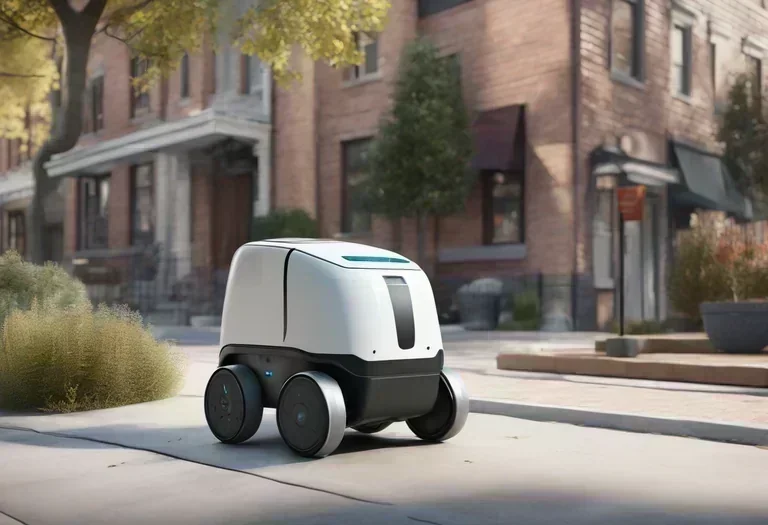
Serve Robotics develops autonomous sidewalk delivery robots designed to transport food and other small orders over relatively short distances. Unlike conventional delivery vehicles, the robots travel primarily on sidewalks and pedestrian-accessible routes.
The robots use a combination of cameras, sensors, mapping technology and artificial intelligence to understand their surroundings. The system allows the robot to identify obstacles, monitor its environment and determine an appropriate path toward its destination.
Autonomous navigation is particularly important for sidewalk delivery because the environment can change constantly. Pedestrians, bicycles, parked objects, construction zones, crossings and other obstacles can appear along a route. A delivery robot therefore needs to continuously interpret its surroundings rather than simply follow a fixed path.
Serve Robotics’ technology is designed to make those decisions without requiring a human driver to control the vehicle at every moment. Remote human oversight can still play a role in autonomous delivery operations, particularly when a robot encounters a situation that requires additional assistance.
The result is a delivery system that combines autonomous navigation with human support infrastructure. The goal is not simply to put a robot on the sidewalk, but to create an operating network capable of handling thousands of deliveries across multiple cities.
How Do Grubhub and DoorDash Fit Into Serve Robotics’ Strategy?
Partnerships with Grubhub and DoorDash are central to Serve Robotics’ expansion because both companies already have established restaurant networks and large customer bases.
For Serve Robotics, integration with major food-delivery platforms can reduce one of the biggest challenges facing a new delivery technology: attracting enough orders to keep the fleet productive. Instead of relying entirely on direct customers, Serve can receive delivery opportunities through established platforms.
For delivery platforms, autonomous robots provide another option for completing short-distance orders. Human couriers can remain important for longer trips and deliveries that are difficult for sidewalk robots, while autonomous vehicles can potentially handle suitable nearby orders.
This creates a hybrid delivery model in which different technologies can be used for different types of trips.
The approach could become increasingly important as food-delivery companies look for ways to improve efficiency. A human courier has to spend time traveling to a restaurant, waiting for an order and then traveling to the customer. A robot can be designed specifically for short-distance deliveries and can operate within a defined geographic area.
The effectiveness of that model will depend on factors including robot utilization, delivery distance, local regulations, operating costs, weather and the ability of the technology to navigate crowded environments.
Where Are Serve Robotics’ Delivery Robots Operating?
Serve Robotics has expanded its operations across multiple U.S. markets. Its reported locations include Chicago, Los Angeles, Alexandria, Virginia, Washington, DC, and San Jose, California, with Miami becoming an important new market as the company establishes additional infrastructure.
Each city presents different challenges for autonomous sidewalk delivery. Urban density, sidewalk design, pedestrian traffic, weather and local regulations can all affect how effectively delivery robots operate.
Los Angeles, for example, provides a large potential market for food delivery and has already become an important area for Serve’s operations. Other markets offer different combinations of restaurant density, residential neighborhoods and pedestrian infrastructure.
Expanding across multiple cities also allows Serve Robotics to gain experience in different environments. That operational data can help the company improve navigation systems, fleet management and the overall reliability of autonomous deliveries.
What Is a Serve Robotics Microdepot?
A microdepot is a smaller local operating facility designed to support an autonomous delivery fleet. Serve Robotics’ first microdepot in Miami gives the company a dedicated location for managing and supporting its robots as it expands in the market.
Microdepots can be useful because autonomous delivery robots generally operate within relatively defined geographic areas. Rather than requiring every robot to travel long distances to reach a service facility, a local depot can provide a convenient base for fleet operations.
A microdepot can support activities such as charging, maintenance, deployment and fleet management. Keeping those functions close to the delivery area can help reduce unnecessary travel and improve operational efficiency.
The Miami facility is therefore more than just another physical location for Serve Robotics. It represents an infrastructure investment that could support a larger fleet and a higher volume of autonomous deliveries.
How Many Restaurants Use Serve Robotics?
Serve Robotics works with more than 4,000 restaurants. That number is significant because restaurant coverage is one of the most important factors in determining whether autonomous food delivery can scale.
A robot fleet needs enough nearby restaurants and customers to generate a consistent volume of delivery opportunities. If orders are too spread out, robots may spend too much time traveling without carrying a delivery.
A large restaurant network can help create denser delivery zones. When several participating restaurants operate within the same geographic area, robots can potentially complete more deliveries without traveling long distances between jobs.
The partnership model also allows restaurants to participate without developing their own autonomous delivery technology. Restaurants can continue receiving orders through established delivery platforms while Serve Robotics provides the robotic delivery capability.
What Happened With Uber’s Investment in Serve Robotics?
Uber has fully divested its stake in Serve Robotics. The move is significant because Uber was an early investor and had been closely associated with the company’s development and expansion.
Uber’s exit changes the ownership landscape around Serve Robotics but does not eliminate the company’s commercial relationships with major delivery platforms. Serve’s ongoing partnerships with companies such as Grubhub and DoorDash remain important parts of its expansion strategy.
The divestment also highlights the changing nature of the autonomous delivery market. Companies that invested in robotics during the industry’s earlier development phase may eventually adjust their holdings as individual businesses become more established and attract new investors.
For Serve Robotics, the focus remains on expanding its robot fleet, increasing restaurant coverage and building the infrastructure needed to operate autonomous deliveries at greater scale.
How Does Serve Robotics Compare With Traditional Food Delivery?
Traditional food delivery generally depends on human couriers using cars, bicycles, scooters or motorcycles. Serve Robotics takes a different approach by using autonomous sidewalk robots for suitable short-distance deliveries.
The most obvious difference is the vehicle itself. A human courier can travel across a large area and handle a wide variety of deliveries, while a sidewalk robot is better suited to relatively short routes within an area where autonomous operation is supported.
That limitation can also become an advantage. Robots are specifically designed for repetitive short-distance delivery tasks and do not require a conventional vehicle or a human driver for every trip.
Autonomous delivery can therefore complement human couriers rather than immediately replacing them. A delivery platform could use robots for nearby orders while continuing to rely on people for longer trips, difficult locations or situations where robotic delivery is not practical.
The economics of that model remain an important factor. Companies need to demonstrate that autonomous robots can operate reliably and at sufficient utilization to justify their purchase, maintenance, charging and support costs.
What Are the Challenges Facing Autonomous Delivery Robots?
Despite the potential benefits, autonomous delivery robots face several challenges as they expand across the United States.
Sidewalk environments can be unpredictable. Pedestrians, bicycles, road construction, temporary barriers, blocked sidewalks and unusual traffic situations can make navigation difficult. Robots must be capable of responding to these conditions safely and consistently.
Weather is another consideration. Rain, extreme heat, snow and other conditions can affect both robot hardware and the ability to navigate sidewalks safely.
Local regulations can also influence where and how autonomous delivery robots operate. Different cities and states may have different rules governing sidewalk robots, operating speeds, right-of-way and interaction with pedestrians.
Public acceptance is equally important. Autonomous robots share pedestrian spaces, meaning people need to be comfortable encountering them on sidewalks and interacting with them when necessary.
Finally, reliability is essential. A food delivery customer expects an order to arrive at the correct location within a reasonable timeframe. If a robot becomes stuck or requires frequent human intervention, the potential efficiency advantages can be reduced.
Why Is Autonomous Food Delivery Growing?
Autonomous delivery has attracted interest because the final stage of a delivery can be one of the most difficult and expensive parts of the logistics process.
For a short food-delivery trip, the actual distance may be small, but a human courier still has to spend time traveling between the restaurant and customer. The cost of that labor can be significant relative to the value of a small food order.
Autonomous robots are designed to address this specific problem. By automating short trips, delivery companies can potentially reduce the amount of human labor required for certain orders while allowing couriers to focus on deliveries that are less suitable for robots.
The growth of online food ordering has created a large potential market for this technology. As consumers become accustomed to ordering meals through smartphones and delivery platforms, companies are looking for new ways to complete those orders efficiently.
Serve Robotics is positioning itself within that market by focusing specifically on sidewalk-based autonomous delivery rather than attempting to develop autonomous vehicles for every type of transportation.
What’s Next for Serve Robotics?
Serve Robotics’ next stage of growth will likely focus on expanding its geographic footprint, increasing the number of robots in service and improving the utilization of its existing fleet.
The company’s Miami microdepot provides a foundation for further expansion in that market. Additional infrastructure could become increasingly important as the number of operating robots grows.
Expanding partnerships with food-delivery platforms and restaurants will also remain important. More restaurant coverage can generate more potential delivery orders, while broader platform integration can increase the number of customers who have access to robotic delivery.
Technology development will remain another priority. Improvements in perception, navigation, fleet management and remote assistance can help robots operate more efficiently and handle increasingly complicated environments.
The long-term goal is to create an autonomous delivery network that can operate reliably at a much larger scale than today’s deployments.
What Does Serve Robotics Mean for the Future of Delivery?
Serve Robotics represents one part of a broader shift toward automation in the logistics and delivery industries. Autonomous technology is increasingly being tested for tasks that involve repetitive short-distance transportation.
Food delivery is particularly suited to experimentation because many orders involve relatively predictable journeys between restaurants and nearby residential or commercial locations.
If autonomous robots can demonstrate reliable operation and competitive costs, their role could expand beyond food. Similar technology could potentially be used for groceries, convenience-store purchases, packages and other small deliveries.
However, widespread adoption will depend on more than technology. Businesses must demonstrate economic value, cities must establish workable regulations, and consumers must accept autonomous robots operating in shared public spaces.
Serve Robotics’ growing fleet and expanding restaurant network provide an early indication of what a larger autonomous delivery ecosystem could look like. The company’s progress will be closely tied to whether it can scale its technology while maintaining reliable service.
Why the Serve Robotics Expansion Matters
Serve Robotics’ expansion is important because it moves autonomous delivery beyond small-scale demonstrations and into a larger commercial operating environment.
More than 2,000 robots are already in operation, the company works with more than 4,000 restaurants, and partnerships with major delivery platforms provide additional opportunities to generate orders.
The establishment of a Miami microdepot is another sign that Serve is building the physical infrastructure required to support a larger autonomous fleet.
The company still faces significant challenges, including navigation, regulation, weather, reliability and economics. But its current footprint demonstrates that sidewalk delivery robots are becoming a practical part of the U.S. food-delivery market rather than simply a technology experiment.
If Serve Robotics can continue increasing fleet utilization, expanding restaurant coverage and improving autonomous navigation, the company’s robots could become a more familiar sight in U.S. cities. The broader result could be a delivery ecosystem in which human couriers and autonomous robots work alongside each other to handle different types of orders.
Specifications
| Specification | Value |
|---|---|
| Company | Serve Robotics |
| Primary Service | Autonomous food delivery |
| Robots in Operation | More than 2,000 |
| Restaurants Served | More than 4,000 |
| Delivery Partners | Grubhub and DoorDash |
| First Miami Microdepot | Established in Miami |
| Operating Markets | Chicago, Los Angeles, Alexandria, Virginia, Washington, DC, San Jose, California and Miami |
| Navigation | Autonomous sidewalk navigation using sensors, cameras and AI-powered software |
| Delivery Model | Short-distance autonomous delivery |
| Uber Investment | Uber has fully divested its stake in Serve Robotics |
Frequently Asked Questions
Q: What is Serve Robotics?
Serve Robotics is a technology company that develops and operates autonomous sidewalk robots designed primarily for food delivery and other short-distance delivery services.
Q: How many Serve Robotics robots are in operation?
Serve Robotics has more than 2,000 autonomous delivery robots operating across the United States.
Q: How many restaurants work with Serve Robotics?
Serve Robotics works with more than 4,000 restaurants through its delivery operations and platform partnerships.
Q: Does Serve Robotics work with DoorDash?
Yes. DoorDash is one of the major food-delivery platforms working with Serve Robotics as the company expands its autonomous delivery network.
Q: Does Serve Robotics work with Grubhub?
Yes. Serve Robotics has partnered with Grubhub to expand access to autonomous food delivery.
How do Serve Robotics delivery robots work?
The robots use cameras, sensors, mapping technology and AI-powered software to navigate sidewalks, identify obstacles and travel toward delivery destinations. Human support can assist when a robot encounters a situation that requires additional intervention.
What is a Serve Robotics microdepot?
A microdepot is a local operating facility that can support an autonomous delivery fleet through functions such as charging, maintenance, deployment and fleet management. Serve Robotics has established its first microdepot in Miami.
Where does Serve Robotics operate?
Serve Robotics has operated in markets including Chicago, Los Angeles, Alexandria, Virginia, Washington, DC and San Jose, California, with Miami becoming another important market as the company expands.
Has Uber sold its investment in Serve Robotics?
Yes. Uber has fully divested its stake in Serve Robotics.
Can autonomous delivery robots replace human couriers?
Autonomous robots are more likely to complement human couriers in the near term. Robots are well suited to certain short-distance deliveries, while human couriers can continue handling longer trips, complex locations and deliveries that are unsuitable for autonomous sidewalk vehicles.
What is the future of autonomous food delivery?
The autonomous food-delivery market is expected to develop as companies improve navigation technology, expand restaurant and delivery-platform partnerships and build the infrastructure needed to operate larger robot fleets. The pace of adoption will depend on reliability, operating costs, regulations and consumer acceptance.