Humanoid Factory Robots Are Here, But Humans Are Still Faster. For Now
BMW, Hyundai, Mercedes, and Tesla are testing humanoid robots for repetitive factory jobs, but experts question their productivity gains.
Key Takeaways
- Automakers including BMW, Hyundai, Mercedes-Benz and Tesla are developing or testing humanoid robots for manufacturing and other industrial tasks.
- BMW has moved beyond an initial demonstration with Figure AI’s Figure 02, using humanoid robots at its Spartanburg plant and reporting that the pilot supported production of more than 30,000 BMW X3 vehicles in 2025.
- BMW’s latest results show that humanoid robots are being evaluated for specific repetitive and physically demanding jobs rather than as immediate replacements for entire human workforces.
- Mercedes-Benz is testing Apptronik’s Apollo humanoid robot in production logistics and component inspection at its Berlin-Marienfelde facility.
- Hyundai Motor Group is developing a broader robotics strategy around Boston Dynamics’ Atlas humanoid robot and plans to introduce humanoids into production facilities, beginning with validation at Hyundai Motor Group Metaplant America.
- Tesla is developing Optimus as a general-purpose humanoid robot for repetitive, unsafe and boring tasks and is preparing production infrastructure for the robot.
- General Motors is pursuing a different approach in some manufacturing applications, developing collaborative robots, or cobots, that can work alongside employees without necessarily using a human-shaped design.
- The central question is no longer simply whether humanoid robots can perform factory tasks. Automakers must determine whether their flexibility, mobility and ability to work in human-designed spaces justify their cost and complexity compared with specialized automation.
- The technology is more likely to change the types of manufacturing jobs available than eliminate human workers entirely in the near term, with maintenance, programming, supervision, quality control and robotics engineering becoming increasingly important.
What’s Driving the Adoption of Humanoid Robots in Factories?
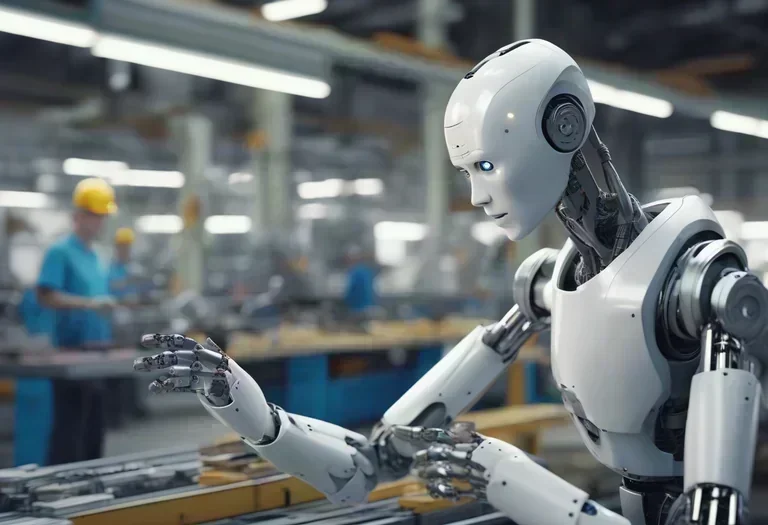
Automakers are increasingly experimenting with humanoid robots because factories contain thousands of repetitive, physically demanding and sometimes ergonomically difficult tasks. Moving components, feeding parts into workstations, transporting materials and performing repetitive inspections can require workers to repeat the same motions throughout a shift. Humanoid robots are being developed as a way to automate some of these jobs without redesigning an entire factory around a specialized machine.
The appeal of the humanoid shape is largely about compatibility with existing environments. Automotive factories were built for people. Doors, aisles, stairs, shelves, workstations, tools and material-handling areas are generally designed around human dimensions and movements. A robot with two arms, two legs and human-like hands can potentially operate in those spaces without requiring every workstation to be rebuilt.
That does not automatically make humanoid robots the most efficient option. A conventional robotic arm can be substantially better at a fixed repetitive movement, while an automated guided vehicle can be more efficient at transporting materials across a factory. A specialized machine can also be designed around one task and optimized for speed, reliability and cost.
The potential advantage of a humanoid robot is flexibility. Instead of building a dedicated machine for every individual process, manufacturers hope one general-purpose robot can be trained to perform multiple tasks and moved between jobs as production requirements change.
BMW’s work with Figure AI illustrates this approach. The BMW Group first tested Figure 02 at its Spartanburg, South Carolina, plant in 2024. During the trial, the robot inserted sheet-metal parts into fixtures used in chassis production. BMW said the task required precision, dexterity and two-handed coordination, while also being physically demanding for human workers.
BMW subsequently reported that its 2025 Spartanburg pilot delivered much more extensive real-world experience. According to the company, Figure 02 worked 10-hour shifts, Monday through Friday, for approximately 1,250 operating hours. During the pilot, it moved more than 90,000 components, took approximately 1.2 million steps and supported production of more than 30,000 BMW X3 vehicles.
The official BMW report on its humanoid-robot deployment provides the company’s latest results and explains how the technology is being evaluated for future production applications: BMW Group.
Those results are important because they show that the technology has progressed beyond a laboratory demonstration. At the same time, BMW’s own description emphasizes specific production tasks rather than suggesting that humanoid robots can currently perform every job on an automotive assembly line.
How Do Humanoid Robots Compare to Human Workers?
The comparison between humanoid robots and human factory workers is more complicated than simply asking which one is faster. A human worker brings dexterity, judgment, adaptability and the ability to handle unexpected situations. A robot brings repeatability, continuous operation, data collection and the potential to perform physically tiring work without fatigue.
Early humanoid robots have also faced obvious limitations. Walking on two legs, manipulating objects with human-like hands and safely interacting with people are technically difficult tasks. A robot may be able to perform a task successfully but still need more time than a trained human employee.
That distinction matters when manufacturers evaluate productivity. If a robot takes longer to perform a task but can work continuously, the economics may still make sense. Likewise, a robot may be valuable even when it is not faster if it removes a particularly awkward or injury-prone task from a human worker’s daily routine.
BMW’s Figure 02 pilot provides an example of this more nuanced approach. The company initially emphasized the robot’s ability to perform precise sheet-metal handling and two-handed manipulation. In its later reporting on the 2025 pilot, BMW said the robot successfully handled more than 90,000 components during approximately 1,250 hours of operation.
The relevant performance metric therefore is not necessarily whether the robot can move faster than a person in a controlled demonstration. Manufacturers need to determine whether the complete system improves productivity, ergonomics, safety, quality or flexibility once the robot is integrated into a real production environment.
There are also significant differences between a humanoid robot and traditional factory automation. A fixed robotic arm can repeat a programmed movement extremely quickly and accurately. It does not need to balance, walk or navigate around obstacles. A humanoid robot has to solve all of those additional engineering problems.
That additional complexity only makes sense if the robot gains something valuable from having a human-like body. The strongest argument is flexibility. A humanoid robot may be able to move through spaces designed for workers and use existing equipment without requiring extensive physical changes to the factory.
BMW’s experience also demonstrates why real-world testing is necessary. The company says its Spartanburg pilot provided information about how humanoid robots interact with production IT infrastructure, occupational safety systems, production processes and shop-floor logistics. Those integration challenges can be just as important as the robot’s physical capabilities.
As a result, it is too early to conclude that humanoid robots are inherently more productive than humans or traditional industrial robots. The technology is being evaluated on a task-by-task and factory-by-factory basis.
What Are the Implications of Humanoid Robots in Factories?
The expansion of humanoid robots in automotive manufacturing raises an obvious question: what happens to the people currently performing the jobs that robots are designed to automate?
Automakers generally frame the technology as a way to handle repetitive, dangerous, physically demanding or ergonomically difficult work. The argument is that robots can take over tasks that are difficult for people while employees move into roles involving supervision, quality control, maintenance, programming and problem-solving.
Hyundai Motor Group, for example, describes its robotics strategy around human-robot collaboration. The company says robots can perform hazardous, dangerous and repetitive tasks while people focus on work requiring greater judgment, creativity and expertise.
Hyundai’s approach is becoming increasingly comprehensive because of its ownership of a controlling stake in Boston Dynamics. The automaker has positioned robotics as part of a broader manufacturing strategy rather than as a standalone technology experiment.
At CES 2026, Hyundai Motor Group announced plans to accelerate the development and commercialization of physical AI and humanoid robotics. The company said its Atlas humanoid robot would eventually be deployed at production facilities, beginning with validation at Hyundai Motor Group Metaplant America in Georgia.
Hyundai has also announced plans to establish a U.S. robot production facility with annual capacity of up to 30,000 units by 2028. The company says the facility will support its broader effort to develop and commercialize humanoid robots.
That expansion suggests automakers are beginning to view humanoid robots as a potential manufacturing platform rather than a novelty. However, deployment at scale will still depend on reliability, safety, cost, battery life, maintenance requirements and the ability of robots to perform useful tasks consistently.
There are also labor implications. If robots eventually become capable of performing a larger percentage of repetitive manufacturing work at lower operating costs, companies could reduce the number of workers required for certain production processes. At the same time, factories would need people capable of maintaining, programming, monitoring and improving increasingly sophisticated robotic systems.
The result could be a shift in the composition of the automotive workforce rather than an immediate end to human manufacturing employment. Assembly workers may increasingly work alongside robots, while demand grows for robotics technicians, automation engineers, AI specialists, safety personnel and production supervisors.
General Motors has taken a particularly explicit position on the continuing role of people. GM says its robotics work is designed to improve safety, quality and ergonomics, while acknowledging that humans remain essential because of their ability to apply judgment, craftsmanship, problem-solving and adaptability.
This distinction is important. Even highly capable robots remain dependent on humans for system design, maintenance, supervision and the broader production environment. A factory that uses hundreds or thousands of autonomous machines still requires people to keep those machines operating and respond when something falls outside the system’s expectations.
How Do Other Automakers Approach Robot Design?
Not every automaker believes every factory task requires a humanoid robot. General Motors is developing multiple forms of robotics, including collaborative robots, or cobots, that are designed to work alongside human employees.
GM’s Autonomous Robotics Center is developing robotics systems using manufacturing data collected over decades. The company is combining robotics with artificial intelligence, simulation and computer vision to improve factory automation.
Unlike a humanoid robot, a collaborative robot does not necessarily need legs or a human-shaped torso. If a task can be completed by a robotic arm mounted on a suitable platform, that design may be simpler and less expensive than building a complete bipedal machine.
That creates an important divide in the future of industrial robotics. One approach focuses on highly specialized machines that perform individual tasks extremely well. The other focuses on general-purpose robots that can potentially perform many different tasks using the same basic hardware.
The official GM robotics program describes the company’s work on collaborative robots and AI-powered manufacturing systems: General Motors.
Mercedes-Benz is taking a more direct humanoid approach. The company is testing Apollo robots developed by Apptronik at its Digital Factory Campus in Berlin-Marienfelde. The initial focus is on intralogistics, including transporting components or modules to production lines and conducting initial quality checks.
Mercedes-Benz’s strategy is notable because the company is not simply testing whether Apollo can walk around a factory. It is training the robot for specific production use cases and integrating it into the company’s broader digital manufacturing ecosystem.
Tesla is pursuing an even broader vision with Optimus. Tesla describes Optimus as a general-purpose, bipedal autonomous humanoid robot intended to perform unsafe, repetitive or boring tasks. The company says its Fremont factory is a hub for Optimus production and has been hiring manufacturing engineers specifically to develop processes for producing the robot.
Tesla’s approach also illustrates the potential difference between using humanoid robots in factories and manufacturing the robots themselves. Tesla wants Optimus to become a mass-produced product, meaning the company has to solve not only the robot’s capabilities but also the economics and manufacturing processes required to build large numbers of humanoid machines.
BMW, Mercedes-Benz, Hyundai and Tesla are therefore pursuing related but distinct strategies. BMW has focused on real production trials with Figure AI. Mercedes-Benz is testing Apollo for logistics and inspection. Hyundai is building a broader robotics ecosystem around Boston Dynamics and Atlas. Tesla is developing Optimus as a general-purpose robot while simultaneously preparing its own manufacturing infrastructure.
What’s Next for Humanoid Robots in Factories?
Humanoid robots are moving from technology demonstrations toward more serious production trials, but that does not mean factories are about to become fully autonomous. The next stage will be defined by economics and reliability as much as by robot capability.
Manufacturers will need to determine whether a humanoid robot can operate for long periods, recover from unexpected situations, work safely around people, maintain acceptable accuracy, and justify its purchase and operating costs.
The most promising applications are likely to be jobs that are repetitive, physically demanding or difficult to staff consistently. Material handling, component movement, machine loading, inspection and repetitive assembly are logical early targets because the tasks can often be clearly defined and measured.
Humanoid robots may also have an advantage when production lines change frequently. A specialized machine may be excellent at one task but difficult to repurpose. A general-purpose humanoid could potentially be retrained for another task, provided its hardware and software are capable of handling the new requirements.
Artificial intelligence will be critical to that flexibility. Traditional industrial robots generally operate within carefully controlled environments and follow highly structured programs. Humanoid robots need to perceive objects, understand their surroundings, plan movements and respond to changes.
The combination of AI and robotics is increasingly being described as physical AI because it allows software intelligence to act directly in the physical world. Hyundai, BMW, Mercedes-Benz and Tesla are all investing in different parts of this broader technology ecosystem.
Safety will remain another major hurdle. A humanoid robot operating near people must be able to detect workers, equipment and unexpected obstacles and respond appropriately. Manufacturers must also determine how robots behave when something goes wrong.
Battery technology is another practical limitation. Humanoid robots require energy for motors, sensors, computing and movement. A production robot that needs frequent charging or battery replacement may be difficult to justify for continuous factory operations.
Cost will ultimately determine how widespread the technology becomes. A humanoid robot does not need to be better than a human at every task to be commercially successful. It needs to provide enough value through productivity, safety, flexibility or labor availability to justify its total cost of ownership.
That is why the latest automotive trials should be viewed as industrial experiments rather than evidence that human workers are about to disappear from assembly plants. BMW’s 2025 deployment showed that a humanoid robot could perform a defined manufacturing task at meaningful scale. Mercedes-Benz is exploring similar technology for logistics and inspection, while Hyundai and Tesla are pursuing much larger robotics strategies.
The most likely near-term future is a mixed workforce in which humans and different types of robots perform complementary jobs. Traditional robotic arms will continue handling highly repetitive tasks, mobile robots will move materials, cobots will assist workers, and humanoid robots will be tested where human-like mobility and manipulation provide a practical advantage.
Whether humanoid robots ultimately become a standard feature of automotive factories will depend on whether their flexibility outweighs their complexity. The technology has progressed significantly, but the automotive industry is still determining where a human-shaped robot provides an advantage that simpler automation cannot match.
Frequently Asked Questions
Q: Which automakers are testing humanoid robots?
A: BMW, Hyundai Motor Group, Mercedes-Benz and Tesla are among the major automakers actively developing or testing humanoid robots. BMW has worked with Figure AI, Mercedes-Benz is testing Apptronik’s Apollo, Hyundai is developing applications for Boston Dynamics’ Atlas, and Tesla is developing its Optimus humanoid robot.
Q: Is BMW using humanoid robots in a real factory?
A: Yes. BMW tested Figure 02 at its Spartanburg, South Carolina, plant and subsequently deployed the technology in a larger 2025 pilot. BMW said Figure 02 operated for approximately 1,250 hours, moved more than 90,000 components and supported production of more than 30,000 BMW X3 vehicles.
Q: What did BMW’s Figure 02 robot do?
A: Figure 02 was used to handle sheet-metal components and precisely position them in fixtures for the body-production process. BMW said the task required accurate manipulation and was physically demanding for human workers.
Q: Are humanoid robots currently faster than human factory workers?
A: There is no broad evidence that humanoid robots are generally faster than skilled human factory workers. Their value is being evaluated using multiple factors, including repeatability, operating time, ergonomics, safety, accuracy and flexibility. A robot can provide value even when it does not outperform a human on raw task speed.
Q: Why do automakers want humanoid robots instead of regular industrial robots?
A: The main potential advantage is flexibility. Humanoid robots can potentially move through spaces designed for people, manipulate objects with human-like hands and perform multiple tasks without requiring a factory to be completely redesigned around specialized machinery.
Q: What is Mercedes-Benz doing with humanoid robots?
A: Mercedes-Benz is testing Apollo humanoid robots from Apptronik at its Digital Factory Campus in Berlin-Marienfelde. Initial applications include intralogistics, such as transporting components to production lines, and initial quality inspections.
Q: What is Hyundai Motor Group doing with humanoid robots?
A: Hyundai Motor Group is developing a broad AI robotics strategy through its relationship with Boston Dynamics. The group plans to validate the Atlas humanoid robot in manufacturing environments, beginning with production facilities that include Hyundai Motor Group Metaplant America in Georgia, before expanding deployment.
Q: What is Tesla Optimus?
A: Optimus is Tesla’s general-purpose bipedal humanoid robot. Tesla says it is being developed to perform unsafe, repetitive or boring tasks. Tesla is also developing manufacturing processes and production infrastructure for Optimus at its Fremont operations.
Q: Is General Motors using humanoid robots?
A: GM is pursuing robotics but is not relying exclusively on humanoid designs. The company is developing collaborative robots, or cobots, as well as AI-powered manufacturing systems. Its approach includes robotic systems designed to work alongside human employees.
Q: Will humanoid robots replace factory workers?
A: Humanoid robots could reduce the need for people in some repetitive or physically demanding jobs, but current deployments are focused on specific tasks rather than replacing entire factory workforces. Human employees remain important for supervision, maintenance, quality control, problem-solving, safety and production management.
Q: What jobs could humanoid robots perform in automotive factories?
A: Potential applications include moving components, supplying production lines, loading and unloading parts, repetitive assembly, machine tending, quality inspections and other physically demanding or repetitive operations. Actual applications will depend on each robot’s capabilities and the requirements of individual factories.
Q: Are humanoid robots better than traditional factory automation?
A: Not necessarily. Traditional robotic arms, automated guided vehicles and specialized machines can be faster, cheaper or more reliable for specific tasks. The potential advantage of humanoid robots is their ability to perform multiple tasks and operate in environments already designed around human workers.
Q: What will determine whether humanoid robots become common in factories?
A: Cost, reliability, safety, battery life, productivity, maintenance requirements and flexibility will determine whether automakers adopt humanoid robots at scale. The technology must provide enough measurable value to justify its complexity compared with conventional automation.