Ford's Off-Road Mustang V8 May Wear a Baja Badge
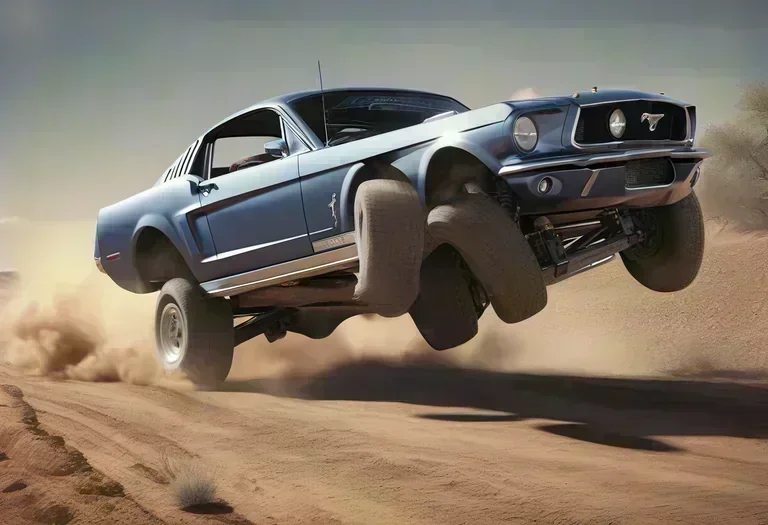
Ford reportedly still has an off-road Mustang in development, potentially wearing a Baja badge.
Key Takeaways
- Ford’s rumored lifted Mustang project reportedly remains active and could be called the Mustang Baja.
- The project was reportedly shown to Ford dealers in 2024 as a more rugged, off-road-focused Mustang.
- Early reports have associated the Baja with V8 power, all-wheel drive, a 10-speed automatic transmission and long-travel suspension.
- Ford has not officially confirmed the Mustang Baja, its name, production status, launch date or specifications.
- An AWD system would make the Baja fundamentally different from the current gas-powered Mustang lineup, which remains rear-wheel drive.
- The Baja name points toward high-speed desert and dirt-road driving rather than traditional rock crawling.
- The concept would likely sit closer to cars such as the Porsche 911 Dakar and Lamborghini Huracán Sterrato than to a conventional off-road SUV.
- Ford already has extensive off-road performance expertise through its Bronco and Raptor programs, making a lifted Mustang technically plausible.
What Is the Ford Mustang Baja?
The Ford Mustang Baja is the reported name of a potential off-road version of the Mustang. Rather than being a simple appearance package with black trim and all-terrain tires, the rumored model is understood to be a substantially reworked Mustang designed to handle dirt, gravel and rougher terrain at higher speeds.
The idea of an off-road Mustang has been circulating for some time. Ford reportedly showed dealers a lifted Mustang project in 2024, giving the proposal more substance than a typical internet rendering or enthusiast concept. More recent reporting suggests the automaker has not abandoned the program and that Baja could be the name attached to the production version if it eventually reaches showrooms.
There is an important distinction between a vehicle being developed and a vehicle being approved for production, however. Ford has not publicly announced the Mustang Baja, and none of the reported specifications should be considered final. Automotive programs can change substantially between dealer previews, engineering development and a potential production launch.
For now, the Mustang Baja is best understood as a reported Ford development project that could turn the traditionally road-focused Mustang into something capable of tackling fast off-road terrain.
Why Would Ford Build an Off-Road Mustang?
At first glance, an off-road Mustang sounds like a contradiction. The Mustang has spent decades establishing itself as a rear-wheel-drive performance coupe, with its strongest associations being straight-line acceleration, road performance and track driving. Raising it and sending it onto dirt would appear to move the car away from its traditional purpose.
That is also what makes the idea interesting.
The performance-car market has increasingly embraced unconventional derivatives. Automakers have discovered that enthusiasts will pay a premium for vehicles that offer a distinct driving experience rather than simply more horsepower. The Porsche 911 Dakar and Lamborghini Huracán Sterrato demonstrated that a sports car can gain ground clearance, specialized suspension and off-road tires without losing its identity as a performance machine.
A Mustang Baja could apply a similar formula to an American muscle car. Instead of turning the Mustang into an SUV, Ford could create a coupe that remains unmistakably a Mustang while adding the hardware needed for high-speed driving over dirt and uneven surfaces.
Ford is also better positioned for this experiment than it might initially appear. The company has considerable experience with high-performance off-road vehicles through the Bronco Raptor, Ranger Raptor and broader Raptor family. Those programs have given Ford considerable knowledge of long-travel suspension, off-road tires, underbody protection, cooling and electronic drive-mode calibration.
The Mustang Baja could therefore combine Ford’s existing sports-car and off-road engineering expertise into one unusual package.
How Does the Ford Mustang Baja Differ From Current Mustang Models?
The biggest difference would likely be the vehicle’s chassis setup and drivetrain rather than its basic engine architecture.
The current Mustang lineup remains heavily focused on traditional rear-wheel-drive performance. The 2026 Mustang GT uses a 5.0-liter V8, while the Dark Horse uses a modified 5.0-liter Coyote V8 producing 500 horsepower. Both can be equipped with a 10-speed automatic, although the Dark Horse also offers a six-speed manual transmission.
The rumored Baja would reportedly take a very different approach. A raised ride height, long-travel suspension and all-wheel drive would give it capabilities that no current conventional Mustang provides.
The reported AWD system would be particularly significant. Every current gas-powered Mustang is rear-wheel drive, so an all-wheel-drive Mustang would require substantial changes to the front-end packaging, drivetrain, suspension and electronic controls.
That change would also make sense for the Baja’s intended environment. Rear-wheel drive is an excellent layout for traditional Mustang performance, but loose gravel, sand and uneven dirt surfaces place a premium on traction. An AWD system could help distribute engine torque more effectively and make the car more stable when accelerating over low-grip terrain.
Will the Ford Mustang Baja Have a V8?
Early reports have described the proposed Mustang Baja as a V8-powered vehicle. That would be a logical choice if Ford wants the model to remain closely connected to the Mustang’s performance heritage.
The current Mustang provides several possible V8 starting points. The 2026 Mustang GT uses Ford’s naturally aspirated 5.0-liter V8, producing up to 486 horsepower with the available active-valve performance exhaust. The Dark Horse uses a modified version of the 5.0-liter Coyote V8 with 500 horsepower.
There has also been speculation about more powerful possibilities, including the supercharged 5.2-liter V8 used by the 795-horsepower Dark Horse SC. That possibility should not be confused with confirmed Baja specifications. There is currently no official indication that Ford plans to give the off-road Mustang anything close to Dark Horse SC power.
In fact, a moderate-output V8 could make more engineering sense for an off-road vehicle. Desert performance is not determined by horsepower alone. Cooling, drivetrain durability, suspension control, tire grip and the ability to withstand repeated impacts are all critical when a vehicle is driven quickly over rough terrain.
Will the Mustang Baja Have All-Wheel Drive?
All-wheel drive is one of the most important reported features of the Mustang Baja. If the feature reaches production, it would represent a major departure for the Mustang brand.
The current gas-powered Mustang uses rear-wheel drive, including the V8-powered GT and Dark Horse. The reported Baja would potentially send power to both axles, giving it additional traction on loose surfaces.
That does not necessarily mean Ford would use the same type of four-wheel-drive hardware found in a traditional body-on-frame SUV. A performance-oriented AWD system could be designed primarily for high-speed driving, allowing the car to manage torque between the axles while retaining road-car refinement.
Such a system could also work with specialized drive modes. A Baja setting could potentially alter throttle response, transmission behavior, stability control, traction management and torque distribution for loose surfaces. Ford already uses dedicated off-road drive modes on its Raptor products, so the company’s existing technology provides a logical foundation for such a system.
What Kind of Suspension Could the Mustang Baja Use?
The reported long-travel suspension could be the defining mechanical feature of the Mustang Baja.
A conventional sports-car suspension is designed to keep the body controlled on relatively smooth pavement. Off-road suspension has a different job. The wheels need enough movement to follow uneven terrain while maintaining tire contact with the surface.
Increasing suspension travel would allow the Baja to absorb larger bumps and compressions without relying entirely on stiff springs and dampers. That would be especially useful for the kind of high-speed dirt driving implied by the Baja name.
However, increasing ride height and suspension travel on a Mustang would create engineering challenges. Ford would need to reconsider the geometry of the front and rear suspension, steering behavior, driveshaft angles, brake lines, cooling systems and underbody components. The car would also need suitable dampers and springs capable of surviving repeated impacts.
Ford’s Raptor experience would be useful here. The Ranger Raptor and Bronco Raptor demonstrate the company’s ability to combine long suspension travel with electronically controlled driving modes and high-performance powertrains. A Mustang Baja would likely require a completely different calibration because of its unibody coupe architecture, but the underlying engineering expertise already exists within Ford.
What Does the Baja Name Suggest?
The Baja name provides a strong indication of what Ford could have in mind.
In automotive culture, Baja is closely associated with desert racing and high-speed off-road competition. The name evokes long stretches of dirt, sand, rocks and rough terrain where speed matters just as much as outright crawling ability.
That makes a Mustang Baja fundamentally different from a traditional trail-focused 4x4.
This probably would not be a Mustang equipped with a low-range transfer case, locking differentials, extreme approach angles and rock-crawling cameras. Instead, the concept would likely emphasize speed across relatively open terrain.
Think of it as a performance coupe that has been given permission to leave the pavement.
That philosophy is similar to the Porsche 911 Dakar and Lamborghini Huracán Sterrato. Both cars retain the fundamental character of their respective sports-car platforms while gaining extra ground clearance, specialized suspension tuning and tires capable of dealing with rough surfaces.
A Mustang Baja could take that concept in a more muscular American direction, pairing a V8 and aggressive bodywork with a raised suspension and off-road hardware.
Could the Mustang Baja Be Called the Mustang Raptor?
Earlier speculation about an off-road Mustang frequently centered on the Mustang Raptor. The emergence of the Baja name suggests Ford may instead want to give the car its own identity.
That would make sense from a branding perspective. Raptor has become strongly associated with Ford’s high-performance trucks and SUVs, while Baja would communicate the Mustang’s desert-racing inspiration without making it appear to be a coupe version of the Ranger Raptor or Bronco Raptor.
There is also a useful distinction in the names themselves. Raptor implies an extreme off-road performance vehicle, while Baja specifically evokes desert racing. For a lifted sports coupe, the latter may be a more appropriate description of the vehicle’s mission.
Could the Mustang Baja Be a RWD Car Instead?
It remains possible that the final production vehicle could differ from early reports. Ford could decide that an all-wheel-drive system adds too much weight, complexity or cost and instead retain rear-wheel drive.
However, AWD would make the Baja more convincing as a dedicated off-road Mustang. Simply raising the ride height of a rear-wheel-drive Mustang and fitting all-terrain tires would improve its dirt-road capability, but it would not fundamentally transform the car.
An AWD system would give Ford a much stronger technical justification for creating an entirely new variant. It could also help distinguish the Baja from the GT and Dark Horse, allowing each Mustang derivative to have a clearer purpose.
Is the Ford Mustang Baja Plausible?
There are several reasons the Mustang Baja is plausible even though Ford has not confirmed it.
First, the Mustang has evolved into more than a single performance formula. The current seventh-generation Mustang is available in multiple configurations, and Ford continues to expand the lineup with increasingly specialized models. The 2026 range includes the 500-horsepower Dark Horse and the 795-horsepower Dark Horse SC, showing how broad the Mustang performance envelope has become.
Second, Ford has demonstrated a willingness to extend established vehicle identities into new segments and use cases. The company has invested heavily in Raptor-branded off-road performance and has continued developing additional Bronco derivatives.
Third, the rumored Mustang Baja reportedly reached the dealer-presentation stage. That does not guarantee production, but it suggests Ford was seriously evaluating the concept rather than merely sketching it for internal design exercises.
Finally, the global market has shown that unusual performance derivatives can attract significant attention. A lifted Mustang would immediately stand out in a crowded performance-car market because there are relatively few high-performance coupes designed specifically for dirt.
What Would the Mustang Baja Compete With?
The Mustang Baja would occupy a very unusual position if it enters production.
Its closest conceptual rivals would likely be the Porsche 911 Dakar and Lamborghini Huracán Sterrato rather than Ford’s own Bronco. Those cars demonstrate the emerging category of elevated performance cars that can handle rough surfaces without becoming conventional SUVs.
However, the Mustang could potentially be much more accessible than those exotic alternatives. A V8-powered, AWD Mustang would offer a combination of sound, performance and practicality that could appeal to buyers who want something more unusual than a standard sports coupe but do not want to move into an SUV.
It could also create a new category for American performance cars. Chevrolet and Dodge have historically focused their muscle-car efforts on pavement, while Ford could give the Mustang a unique off-road identity.
Could the Mustang Baja Be Sold in the Philippines?
Ford already has an established Mustang presence in the Philippines, making the country a potentially interesting market for any future off-road Mustang derivative.
The Philippines also has an established market for adventure-oriented vehicles. Ford’s local lineup includes off-road-focused products such as the Bronco and Ranger Raptor, giving the brand an existing customer base familiar with performance-oriented vehicles designed for rough terrain.
There is no confirmed Philippine-market Mustang Baja, however. Even if Ford eventually produces the model, availability in the Philippines would depend on the company’s global distribution strategy, local certification, pricing and demand.
For Filipino buyers, the most important question would likely be whether Ford treats the Baja as a limited global performance model or a broader Mustang variant. A limited-production model could be considerably harder to obtain than the regular Mustang GT or Dark Horse.
When Could the Ford Mustang Baja Debut?
Ford has not announced a launch date for the Mustang Baja.
Reports suggesting that the project remains under development do not necessarily mean the vehicle is close to production. Automakers frequently evaluate new derivatives over several years, and projects can be redesigned, delayed or cancelled even after being shown to dealers.
That means any specific launch-year claim should be treated carefully until Ford provides an official announcement.
The strongest conclusion at this stage is that the off-road Mustang concept has reportedly survived beyond its initial dealer presentation and remains a possibility for the future Mustang lineup.
What Could Make the Mustang Baja Special?
The appeal of the Mustang Baja would come from the combination of features rather than any single specification.
A V8-powered coupe with all-wheel drive would already be unusual. Adding a raised ride height and long-travel suspension would make the vehicle even more distinctive. Add underbody protection, aggressive tires and off-road-oriented electronic controls, and the result could be a Mustang unlike anything Ford currently sells.
The most compelling aspect would be the ability to use the car differently from a conventional sports coupe. A standard Mustang encourages drivers to seek out smooth roads, highways and racetracks. A Baja could encourage them to find dirt roads, gravel routes and open desert terrain instead.
That difference in character could be enough to justify the model even if it is not the fastest Mustang around a circuit.
What Could Go Wrong With the Mustang Baja?
Building an off-road performance coupe would not be without compromises.
Additional suspension travel and AWD hardware could increase weight. A taller ride height could also affect aerodynamic performance and high-speed cornering compared with a lower Mustang. Off-road tires would likely produce more road noise and potentially reduce ultimate grip on dry pavement.
There would also be significant durability requirements. A vehicle designed to travel quickly over rough terrain needs stronger suspension components, effective cooling and sufficient protection for its underside. Those changes could increase both the development cost and retail price.
Ford would therefore need to strike a careful balance. The Baja would have to be capable enough off-road to justify its existence while remaining fun and competent on pavement.
Ford Mustang Baja Specifications
| Specification | Reported or Expected Value |
|---|---|
| Model | Ford Mustang Baja |
| Vehicle Type | Lifted off-road performance coupe |
| Engine | V8 reported |
| Transmission | 10-speed automatic reported |
| Drive Type | All-wheel drive reported |
| Ride Height | Raised compared with standard Mustang, reportedly |
| Suspension | Long-travel suspension reported |
| Underbody Protection | Reported |
| Tires | Off-road-oriented tires expected |
| Primary Use | High-speed dirt and desert driving |
| Production Status | Unconfirmed development project |
| Launch Date | Not announced |
| Price | Not announced |
These Mustang Baja specifications are based on reported information and should not be treated as final Ford specifications. The company has not officially announced the vehicle.
Conclusion
The Ford Mustang Baja could become one of the most unconventional Mustang derivatives ever produced. A lifted stance, long-travel suspension, all-wheel drive and V8 power would move the Mustang into territory traditionally occupied by off-road trucks and SUVs while preserving the basic appeal of a two-door performance car.
The project remains unconfirmed, and that distinction is important. Ford has not announced the Baja name, production schedule, drivetrain or final specifications. The reported dealer presentation and subsequent reports nevertheless suggest that the idea has received serious consideration.
If Ford decides to build it, the Mustang Baja could offer something few other performance cars can: the ability to combine classic V8 muscle-car character with high-speed off-road capability. Rather than turning the Mustang into an SUV, Ford could create a desert-focused sports coupe that occupies a category of its own.
Frequently Asked Questions
Q: What is the Ford Mustang Baja?
The Ford Mustang Baja is a rumored off-road performance version of the Mustang. Reports describe it as a lifted coupe with V8 power, all-wheel drive, long-travel suspension and additional protection for rough terrain.
Q: Has Ford confirmed the Mustang Baja?
No. Ford has not officially confirmed the Mustang Baja, its name, production status, specifications or launch date.
Q: Will the Ford Mustang Baja have a V8?
Early reports indicate that the Mustang Baja would use a V8 engine, but Ford has not confirmed the engine or its power output.
Q: Will the Mustang Baja have all-wheel drive?
All-wheel drive has been reported as a planned feature. If confirmed for production, it would make the Baja substantially different from the current gas-powered Mustang lineup, which uses rear-wheel drive.
Q: What does the Baja name mean?
The Baja name refers to the model’s reported focus on high-speed off-road driving. It suggests a vehicle designed for dirt, gravel, desert terrain and rough roads rather than traditional low-speed rock crawling.
Q: How would the Mustang Baja differ from the Dark Horse?
The Dark Horse is primarily focused on high-performance road and track driving, while the rumored Baja would prioritize off-road capability through increased ride height, longer suspension travel, all-wheel drive and additional protection.
Q: Could the Mustang Baja have long-travel suspension?
Yes. Long-travel suspension has been included in reports about the project. It would allow the wheels to move farther over uneven terrain and would be an important component of a high-speed off-road Mustang.
Q: Could the Mustang Baja be called a Mustang Raptor?
Earlier speculation used the Mustang Raptor name, but more recent reporting has associated the project with the Baja name. Ford has not confirmed either name for a production vehicle.
Q: When will the Ford Mustang Baja be released?
There is currently no confirmed release date. Ford has not announced when, or if, the reported Mustang Baja will enter production.
Q: Will the Ford Mustang Baja be available in the Philippines?
There is no confirmed Philippine-market Mustang Baja. If Ford eventually produces the model, availability in the Philippines would depend on the company’s global distribution strategy and local market requirements.